
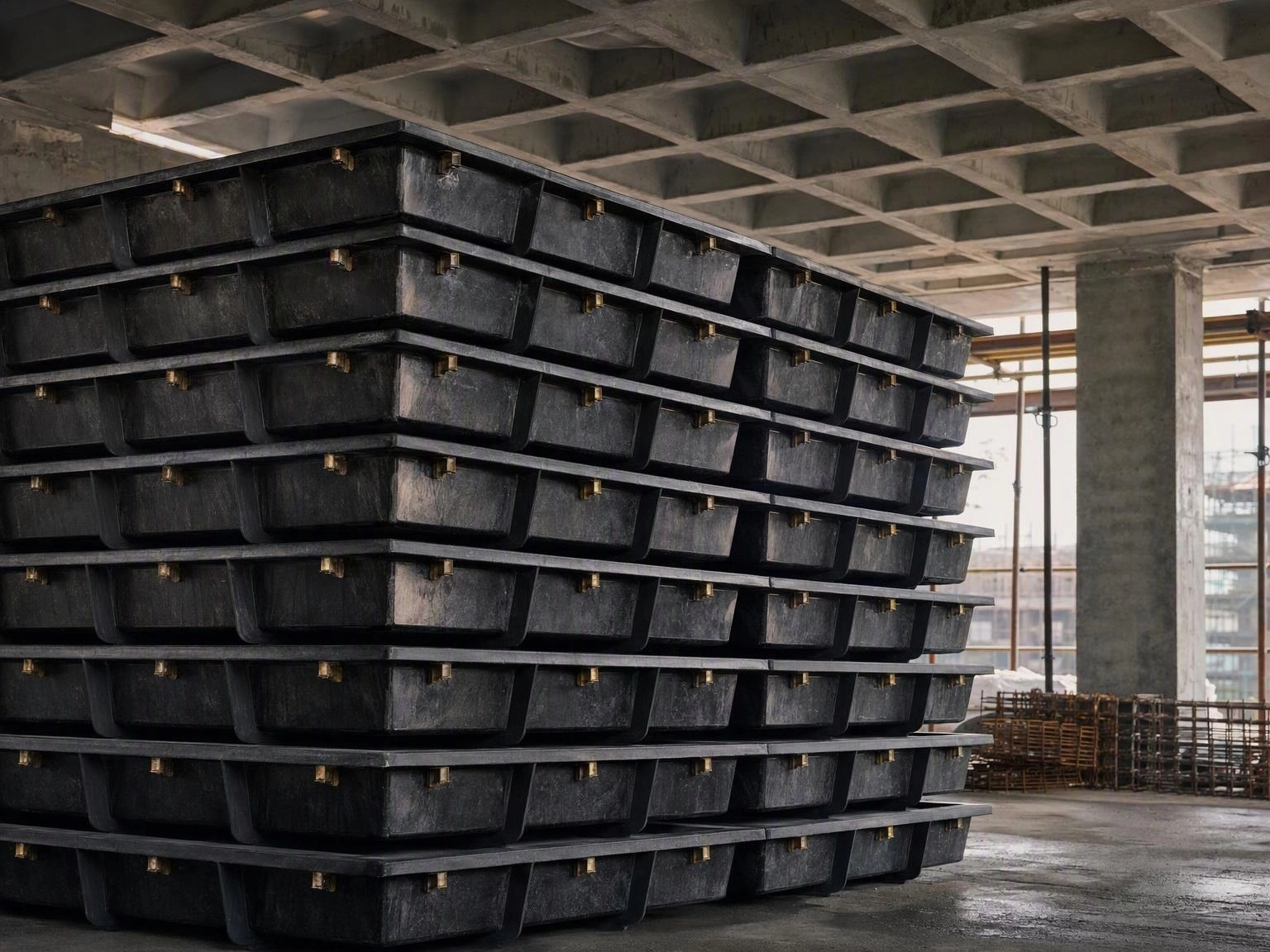
Waffle slab and ribbed slab construction saves concrete and reduces structural weight by creating voids in the slab. The voids are formed by reusable boxes — traditionally timber, increasingly thermoformed plastic, and in demanding projects SMC glass fiber reinforced plastic.
Because the box is reused many times, the purchase price is the wrong number to compare. What matters is cost per casting, and that depends on how many cycles the box survives and how good the concrete finish is.
What the application demands
- Dimensional stability. Every box must be the same size, batch after batch, or the slab soffit shows variation.
- Release. Concrete must release cleanly without damaging the box surface or leaving a rough finish that needs patching.
- Compression strength. Wet concrete is heavy. The box must resist the hydrostatic and construction loads without deflecting.
- Repeated stripping. Boxes are stripped, cleaned and reused, often on a tight cycle.
- Site handling. They are thrown, stacked and dropped. Impact toughness matters as much as strength.
Timber: cheap, but the cost is in labour
Timber boxes are inexpensive to make and can be built on site, which is why they remain common in low-labour-cost markets. Their weaknesses are dimensional drift, water absorption, surface deterioration after a few cycles, and the labour required to build, repair and strip them. Over a large project, the labour line usually exceeds the material line.
Thermoformed plastic: good until it is not
Vacuum-formed PP or ABS boxes are light, cheap and release reasonably well when new. The limitation is creep and impact: under sustained load and site heat, thin thermoplastic walls deform, and a dropped box cracks. Cycles are typically limited, and once the surface is scuffed, release quality drops quickly.
SMC FRP: higher price, lower cost per casting
SMC compression molding produces a dense, stiff, dimensionally stable box with molded-in ribs and a smooth gel-coated surface. The advantages show up over a project rather than on the invoice:
- Cycle life. A properly molded SMC box withstands far more strip-and-reuse cycles than thermoformed plastic, and its geometry does not creep.
- Surface quality. A gel-coated mold surface releases cleanly and produces a fair-faced soffit that may not need plastering.
- Rib geometry. Compression molding allows deep, efficient ribs that would be difficult to form in thermoplastic without thick walls.
- Consistency. Every box from the same tool is identical, which simplifies stacking, alignment and slab thickness control.
The trade-off is tooling cost and unit price. On a project with a few hundred castings, thermoplastic wins. On a high-rise with tens of thousands of square metres of slab, the SMC box is usually the cheaper option in total.
Design details that matter
- Draft angle. Sufficient draft is what makes stripping quick; too little and boxes are damaged during removal.
- Rib layout. Ribs should follow the load path from the top face to the base flange, with generous fillets to avoid stress concentration.
- Stacking features. Interlocking feet or a nesting profile reduce site handling damage and speed up installation.
- Handholds. Molded-in lifting points are used far more than anyone expects.
- Sealing against grout. The interface between box and slab must prevent grout ingress, which adds weight and makes stripping difficult.
How Shengtian molds waffle boxes
Guangdong Shengtian Technology produces SMC FRP waffle boxes by compression molding, with molds designed for the draft, rib layout and stacking features that site use demands. The same facility molds other SMC construction and industrial components, so the process knowledge is not limited to a single product.
For contractors and formwork suppliers, we can quote on a per-project basis including tooling amortisation, so the comparison against timber or thermoplastic is made on cost per casting rather than on unit price.