
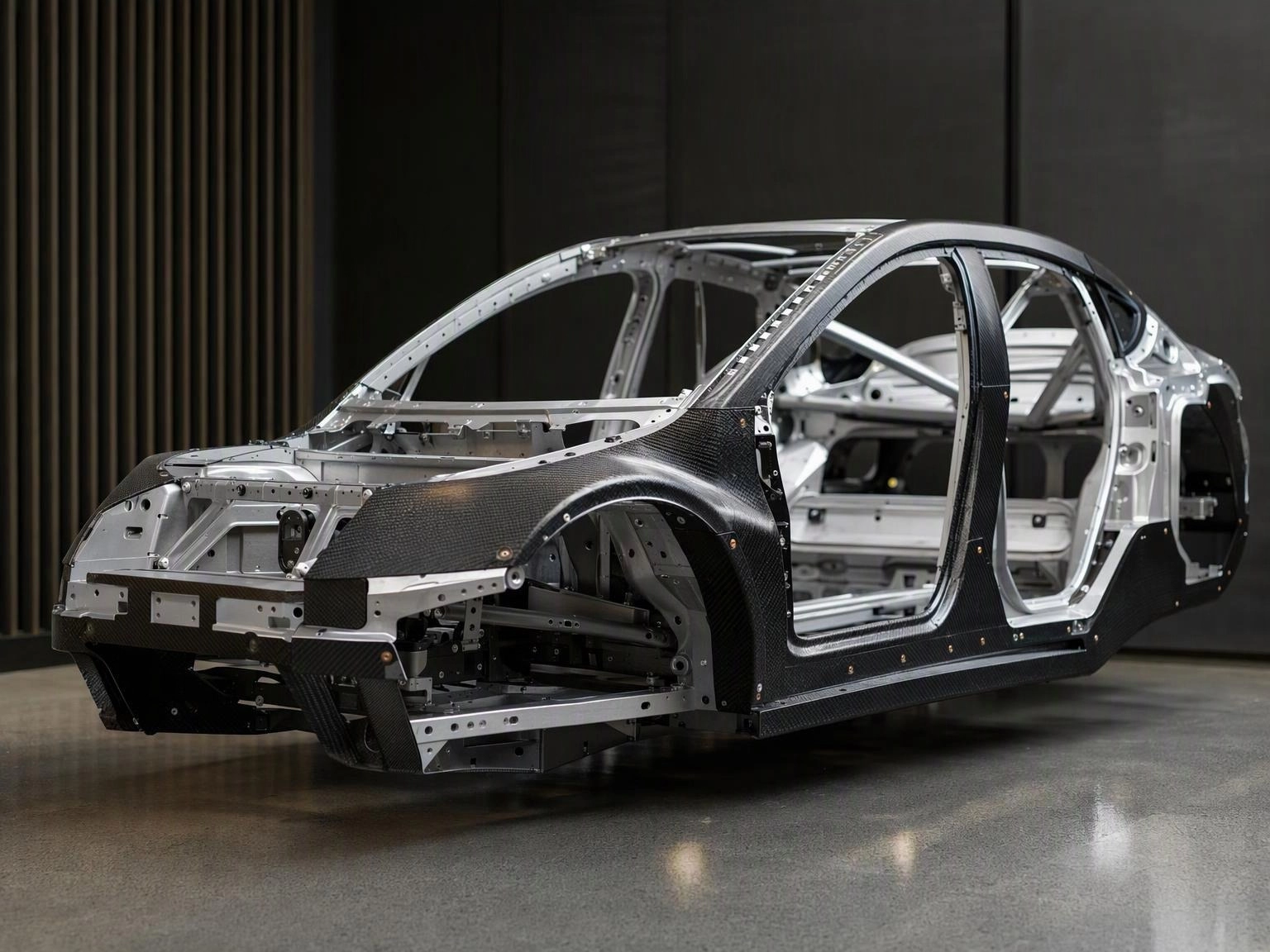
Every electric vehicle programme begins with a mass target that the battery keeps making harder to hit. Lightweighting is no longer a performance nicety — it is a range strategy. But carbon fiber is expensive, and applying it indiscriminately is how a lightweighting programme destroys its own business case.
This article looks at where composites earn their cost on an EV, and where they do not.
Why mass costs more on an EV
On a combustion vehicle, mass affects acceleration, braking and fuel consumption. On an EV, it also propagates into the battery. A heavier car needs more energy per kilometre, which needs a larger battery, which adds more mass — the classic mass spiral. Breaking that spiral at the body and chassis has a multiplier effect that does not exist in a conventional powertrain.
Mass high in the vehicle and mass in unsprung components has an outsized effect on handling and ride, which is why carbon fiber roofs, hoods and wheel components appear even on low-volume performance EVs.
Where carbon fiber returns the most value
- Large closure panels. Hoods, roofs and trunk lids are big, visible and stiffness-limited rather than strength-limited. A carbon hood can remove several kilograms from the highest point of the car and simultaneously deliver a premium appearance that would otherwise require paint and a separate cosmetic process.
- Structural battery enclosure components. The battery case is one of the heaviest single assemblies in an EV. Composite covers and internal structures offer stiffness, corrosion immunity and — importantly — the ability to mold in geometry that would require many steel stampings.
- Aero and exterior addenda. Spoilers, diffusers, mirror housings and trim are relatively small parts with high perceived value, where a visible weave supports the brand positioning as much as the mass saving.
- Interior structural and semi-structural parts. Seat frames and load floors benefit from molded-in features and low tooling cost at moderate volumes.
Where composites usually lose
- High-volume simple stampings. A steel or aluminum part produced on an existing press line at hundreds of thousands of units per year will beat a composite on cost, whatever the mass advantage.
- Parts dominated by crash energy absorption in a low-cost platform. Composites can absorb energy extremely well, but the validation cost and the repair strategy must be funded.
- Anything requiring large-scale repairability at low cost. A dented steel fender is repaired in an afternoon; a delaminated carbon panel is replaced.
The cost conversation, honestly
Carbon fiber parts cost more per kilogram than steel or aluminum. The business case rests on three offsets:
Part consolidation. A molded composite assembly can replace a dozen stamped and welded pieces plus their fixtures and fasteners. The saving is in tooling count, assembly time and dimensional stack-up, not in material price.
Tooling economics at low volume. A steel stamping die is a large fixed cost, justified only at high volume. A composite tool can be far cheaper, which makes carbon fiber competitive in exactly the low- and mid-volume segments that many EV start-ups occupy.
Finish as function. A visible carbon part with a clear coat needs no paint line. Eliminating a paint step removes cost, floor space and emissions from the plant.
Design rules that keep a composite EV part competitive
- Design for the process you have chosen, not for the metal part being replaced. A composite part that copies a stamped geometry is usually heavier and more expensive than it needs to be.
- Keep wall thickness as uniform as possible; thick sections waste material and create cure gradients.
- Place ribs where the load path runs, and avoid abrupt section changes that concentrate stress.
- Consider galvanic isolation wherever carbon meets aluminum; it is a detail that will otherwise appear in field returns.
- Agree the cosmetic standard early — on a visible part, finishing can be a third of the cost.
How Shengtian supports EV and automotive programmes
Guangdong Shengtian Technology manufactures carbon fiber engine hoods, rear spoilers and other automotive components in a 10,000 m² facility with an independent Class 10,000 dust-free painting workshop, and operates under IATF 16949 and ISO 9001 quality systems. Capabilities cover carbon fiber pressing, autoclave curing and SMC molding, so a programme can mix processes across a part family rather than forcing every part through one route.
For EV developers, we typically start with one or two visible parts to establish the cosmetic standard and the supply rhythm, then extend into structural components once the process is proven.
Carbon fiber engine hood · Carbon fiber rear spoiler · Automotive parts