
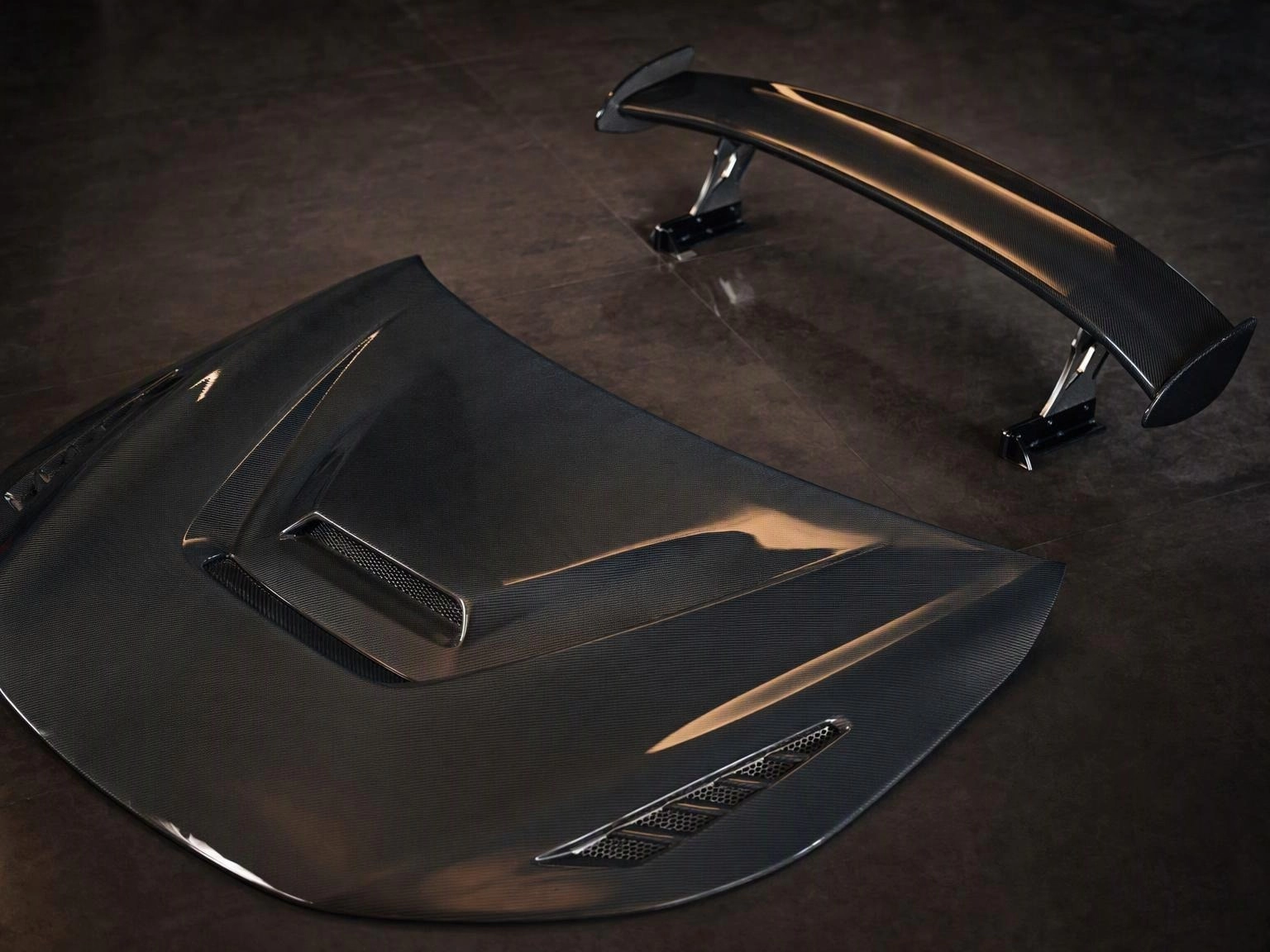
The aftermarket carbon fiber market is unforgiving. A hood that needs trimming to fit, or a spoiler whose clear coat turns amber after six months, generates returns, chargebacks and reviews that no amount of marketing can offset. The difference between a part that sells and one that fails is almost entirely in tooling and process control.
Fitment starts with tooling, not with the part
The single most important input to a well-fitting carbon hood is the master model it was tooled from. Two routes are common:
- OEM-style tooling: the mold is built from the original body panel or a scan of it, so mounting points, shut lines and curvature match the vehicle.
- Reproduction tooling: the mold is taken from an existing aftermarket part. Every error in the source part is inherited and usually amplified.
For a new programme we prefer to tool from an OEM panel, a high-resolution scan or a verified CAD surface. The extra tooling cost is small compared with the cost of a rejected container.
The details that decide whether it bolts on
- Mounting points. Metal inserts should be positioned and molded in — not drilled afterwards — and should be compatible with the original hinges, struts and latches.
- Gas strut compatibility. A carbon hood is much lighter than steel, so an original strut will over-lift it. Either specify a matched strut or design for a prop rod.
- Panel gap and edge thickness. Compression and autoclave tools should produce edges thin enough to sit flush in the shut line, with a controlled radius so the part does not read as a slab.
- Understructure. A single-skin hood will flutter at speed. Molded-in ribs or a bonded inner frame are required, not optional.
- Drainage and sealing. Water trapped between the carbon skin and the inner frame is a common cause of galvanic corrosion at the fasteners.
Clear coat: the part that ages
Epoxy-based carbon parts yellow when exposed to UV. Without a UV-stable clear coat, a black hood becomes bronze within a season, and no polishing will restore it. A proper automotive clear coat system — applied in a dust-free, temperature-controlled booth and fully cured — is what determines whether the part still looks premium in year three.
Three practical checks buyers can make:
- Ask which clear coat system is used, and whether it is a 2K polyurethane or equivalent UV-stabilised product.
- Request a QUV or accelerated weathering report if the part will be sold in high-sun markets.
- Inspect a sample for pinholes under raking light; pinholes are where coating breakdown begins.
Batch consistency: the hidden cost of a cheap part
Aftermarket buyers compare parts across batches. If the second shipment has a slightly different weave direction, a different gloss level or a slightly different shade, it will be returned as “not as described”.
Consistency requires documented standards: an approved physical sample retained at the factory, a defined weave orientation, a gloss target in gloss units, and a colour measurement under specified lighting. It also requires the discipline to hold a batch when it deviates, rather than shipping and hoping.
Mass, stiffness and the honest claims
A carbon hood is lighter than steel or aluminum, and stiffer per kilogram. What it is not is indestructible: carbon is strong in tension but brittle under point impact, and a stone chip at speed can produce a star crack that a metal panel would have absorbed as a dent. Buyers should be told this, and products sold for track use should be labelled accordingly.
How Shengtian produces automotive carbon parts
Guangdong Shengtian Technology manufactures carbon fiber engine hoods, rear spoilers and interior parts for performance vehicles, using carbon fiber pressing and autoclave curing, with an independent Class 10,000 dust-free painting workshop for clear coat. The facility operates under IATF 16949 and ISO 9001, and production is supported by in-house tooling so that fitment issues can be corrected at the mold rather than worked around at assembly.
Our recent programmes include carbon fiber hoods and rear spoilers for Xiaomi vehicles, developed from vehicle data with matched mounting hardware and a sample-approved cosmetic standard.
If you are developing a body part for a specific model, send the vehicle details and we will confirm tooling availability, sample lead time and the cosmetic standard we can hold in production.
Carbon fiber engine hood · Carbon fiber rear spoiler · Automotive parts