When an automotive programme moves from prototype to production, quality documentation becomes as important as the part itself. Tier 1 suppliers and OEMs will ask a composite manufacturer for IATF 16949 certification — and increasingly they will ask what lies behind it.
This article explains what the standard requires in practice for a carbon fiber and composite parts supplier, and what a sourcing team should actually verify.
What IATF 16949 is
IATF 16949 is the automotive quality management system standard, built on ISO 9001 and extended with automotive-specific requirements: advanced product quality planning, production part approval, control plans, measurement system analysis, and a formal approach to risk. It is required by most OEMs of any supplier that touches a production vehicle part.
ISO 9001 alone covers general quality management. IATF 16949 adds the discipline that automotive production demands: documented process capability, traceability, change control and a structured response to nonconformance.
The documents that matter in a real audit
- Control plan. The document that says, for each production step, what is checked, how often, and what the reaction is when it fails. A supplier without a control plan is inspecting by habit.
- PFMEA. Process failure mode and effects analysis, showing that the supplier has thought about what can go wrong in molding, bonding, machining and finishing — and what prevents it.
- PPAP package. Production part approval: dimensional results, material certification, appearance approval, capability studies and sample parts from the production tool, not from a prototype tool.
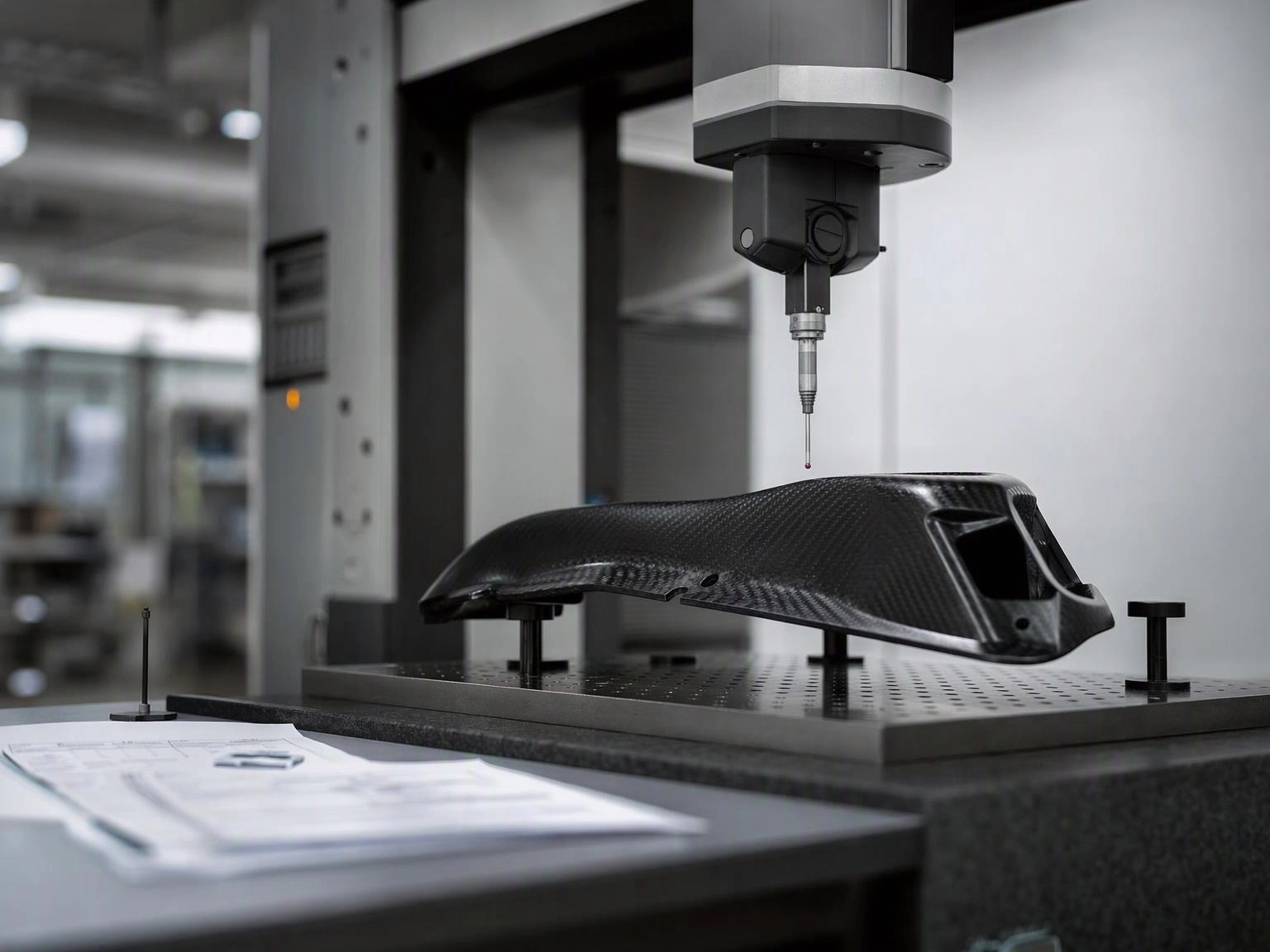
- MSA. Measurement system analysis, proving that the gauges used to accept the part are themselves capable. On composite parts, this often matters for thickness and profile measurement.
- Traceability records. Which prepreg batch, which cure cycle, which operator, which tool. When a defect appears in the field, this is what allows a containment to be defined in days rather than months.
Composite-specific quality issues the standard forces you to control
Composites bring process variables that metal does not: resin out-time, cure temperature and pressure records, ply orientation, void content, and the condition of the mold surface. A certified system should have documented control over each, plus a reaction plan when a cure record shows a deviation.
Two questions worth asking any composite supplier:
- How do you record and retain cure cycles, and what happens if a cycle deviates from the validated envelope?
- How do you control prepreg shelf life and out-time, and where is it recorded?
A supplier who answers these specifically has a working system. A supplier who answers with a certificate number does not.
Appearance: the criterion that gets negotiated
On visible carbon parts, appearance is a functional requirement for the customer but a subjective one for the factory. IATF requires an appearance approval process, and in practice this means agreeing on a master sample, a viewing condition and a defect acceptance limit before production starts. Without that agreement, every shipment becomes a negotiation.
Change control: the quiet risk
A supplier that changes resin system, prepreg source or a sub-supplier without notification can invalidate the PPAP and, in the worst case, the vehicle's validation. IATF requires notification of changes. Buyers should confirm that the obligation is written into the supply agreement, with a defined approval flow.
What a factory visit should confirm
- Separate and identified material storage with temperature and humidity control for prepreg.
- Calibrated curing equipment with recorded cycles, not just a dial on the wall.
- A clean, controlled painting or finishing area for cosmetic parts.
- A quarantine area for nonconforming parts, actually in use.
- Inspection fixtures that match the drawing's datum scheme.
Shengtian's quality framework
Guangdong Shengtian Technology operates under ISO 9001 and has established an IATF 16949:2016 quality management system for its automotive composite production, supported by a 10,000 m² facility, in-house tooling and a Class 10,000 dust-free painting workshop.
For automotive customers we provide the documentation package appropriate to the programme stage — from dimensional reports and material certificates at sample stage to control plans and PPAP documentation at production. If your programme requires a specific document set, tell us the format at RFQ stage so it can be included in the quotation rather than discovered later.