
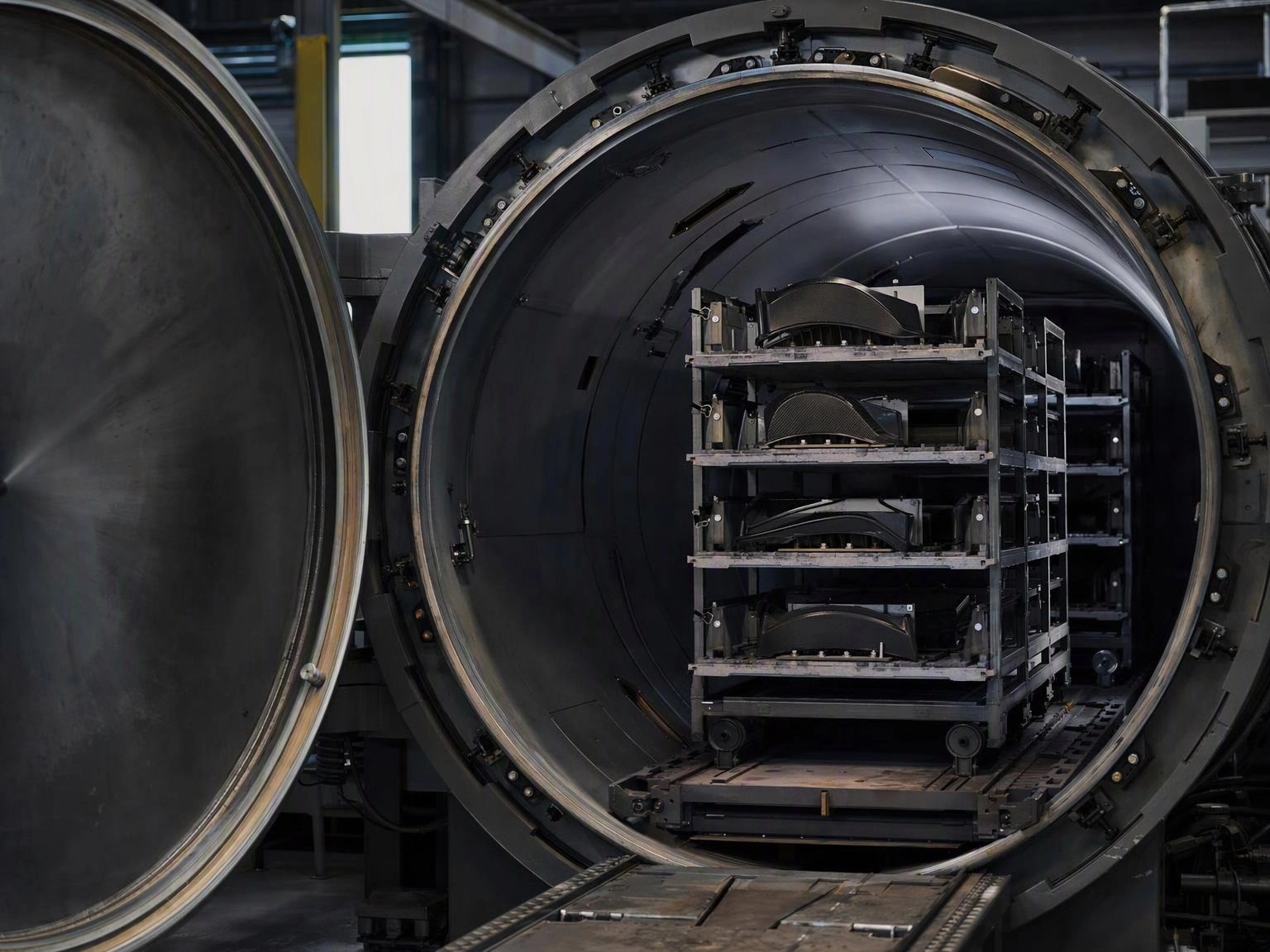
For high-performance composite parts, cure pressure is the single biggest lever on internal quality. An autoclave applies heat and several bar of pressure simultaneously, collapsing voids and consolidating the laminate to a degree that vacuum alone cannot match. The question for most projects is whether the part actually needs that quality — because the cost difference is substantial.
What pressure does to a laminate
During cure, the resin flows, volatiles are released and trapped air must escape. Under vacuum alone, the driving pressure is roughly one atmosphere. Under autoclave pressure of 3 to 7 bar, voids are compressed far more aggressively, resin is drawn into dry regions, and the fiber volume fraction rises.
The results are measurable: lower void content, better interlaminar shear strength, less scatter in mechanical test data, and a surface that shows less porosity after finishing. This is why aerospace primary structure, racing components and high-end cosmetic parts are commonly autoclaved.
Out-of-autoclave: what has changed
Out-of-autoclave (OOA) prepregs are formulated with engineered permeability so that air and volatiles can be removed under vacuum only. Modern OOA systems reach void contents low enough for many structural applications, though typically not quite matching the best autoclave results.
The advantages are practical: no pressure vessel, much larger parts possible without a giant autoclave, lower energy use, and faster cycle times when an oven is paired with quick tooling. For large structures — boat hulls, wind components, architectural panels, rail interiors — OOA is often the only viable route.
The comparison that drives the decision
- Mechanical requirement. If the part is primary structure with tight allowables, autoclave is the conservative choice. If it is secondary structure with a healthy safety factor, OOA is usually sufficient.
- Part size. Autoclave size is a hard constraint; a part larger than the vessel is simply not an autoclave part.
- Cosmetics. Autoclave pressure reduces surface porosity, which shortens finishing time on visible parts. The saving in labour can offset part of the autoclave cost.
- Volume. Autoclaves are batch tools. High-volume small parts are better served by compression molding or pultrusion, where cycle time is minutes and tooling is amortised over thousands of units.
- Tooling. Autoclave tooling must survive pressure and repeated thermal cycling; invar or steel tooling is expensive. OOA and press tooling can often use lighter, cheaper materials.
Where autoclave is genuinely necessary
In our experience the autoclave earns its cost in three situations: complex sandwich structures where core-to-skin bonding must be flawless, thick laminates where consolidation is difficult, and cosmetic parts that must be perfect without heavy finishing. Motorsport bodywork, UAV structural components and premium consumer products with visible weave fall into this space.
For simple constant-section parts — tubes, rods, profiles — pultrusion or roll-wrapping under tension already delivers excellent consolidation at a fraction of the cost, and an autoclave adds little.
Process control is worth more than the vessel
A well-run OOA process beats a poorly controlled autoclave. The variables that decide quality are the same in both cases: accurate thermocouple placement, a validated cure ramp, bag integrity, leak rate, and documented traceability of prepreg batch and out-time. Buyers auditing a supplier should ask for cure records, not just a photograph of a pressure vessel.
How Shengtian uses both routes
Guangdong Shengtian Technology operates autoclave curing for its carbon fiber press and prepreg parts, including automotive body components and lifestyle products where surface quality is the product, and uses press and pultrusion routes where the load case does not justify autoclave cost. Recommendation is made from the part requirement, not from available capacity.
Send us the part, the load case and the cosmetic standard, and we will tell you which cure route delivers it at the lowest total cost — including the finishing labour that a lower-porosity surface saves.
Carbon fiber engine hood · Carbon fiber rear spoiler · Automotive parts