
Sourcing composite parts is different from sourcing machined metal. The material is made and the part is made in the same operation, so the factory's process discipline becomes part of the product's properties. A supplier with good equipment and poor records will produce a first batch that passes and a fifth batch that does not.
This article is a practical audit checklist for a buyer qualifying a carbon fiber or fiberglass manufacturer, written from the production side.
1. Confirm the factory actually makes what you are buying
The first question is not “can you make it” but “show me where you make it”. Many trading companies present a showroom and subcontract production. Ask to see the specific equipment for your process:
- Pultrusion: a pulling line with a heated die sized to your profile.
- Roll-wrapping: mandrels, wrapping stations, curing ovens, extraction equipment.
- Compression molding: presses with the tonnage and platen size for your part, plus the tool.
- Autoclave: a vessel large enough for your part, with a recorded cure controller.
If the machine for your process is not on site, the process is being subcontracted and the quality system you audited does not apply to your part.
2. Look at the material store, not the brochure
Prepreg and resin have shelf lives and out-times. A serious factory has a temperature-controlled store, labelled batches, and a record of what was taken out and when. If prepreg is sitting on an open rack next to the packing area, the mechanical properties in the datasheet are not the ones you will receive.
3. Ask for a cure record, then ask what happens when it deviates
Every composite part passes through a thermal cycle that determines its properties. The factory should be able to show a recorded cycle — time, temperature, pressure, vacuum — linked to a batch. The more revealing question is the second one: what is the reaction plan when a cycle goes out of the validated window?
A supplier with a working system will describe a hold, an engineering review and a documented disposition. A supplier without one will say “it is usually fine”.
4. Inspect the measurement fixtures
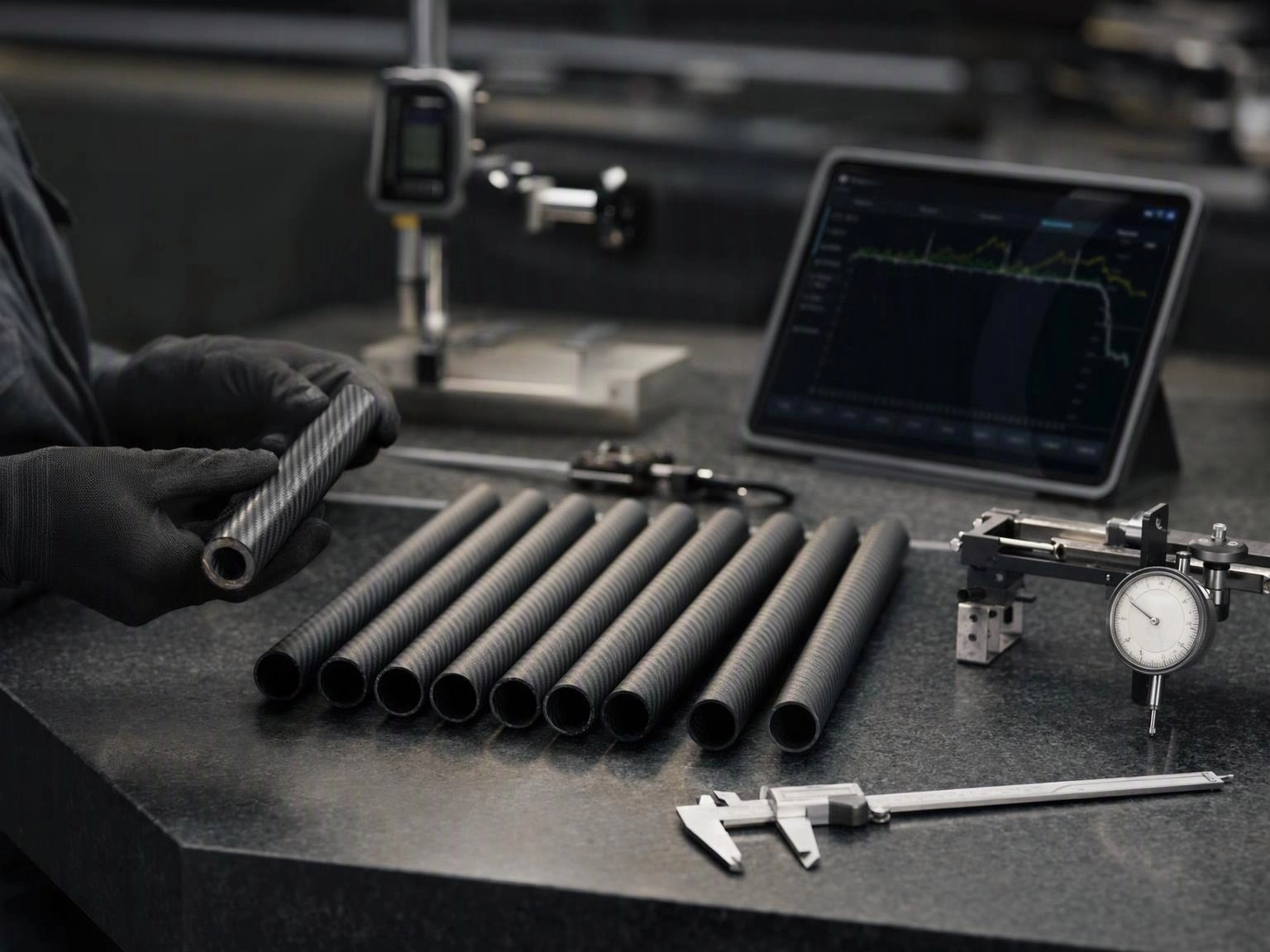
Composite parts are difficult to measure: they are compliant, they spring back, and their surfaces are cosmetic. Ask how the supplier checks the dimensions on your drawing, and look at the fixture. A height gauge on a surface plate is fine for a rod; a tube with a straightness callout needs a proper V-block setup, and a cosmetic part needs a defined viewing booth.
Also check calibration labels. An expired calibration on the gauge that accepts your part is a systemic finding, not a clerical one.
5. Understand how samples are approved
The sample process tells you how production will be judged. Good practice: a physical master sample signed by both parties, retained at the factory, with a written acceptance standard for the defects that matter (weave alignment, pinholes, gloss, colour). Weak practice: a photo approved by email and no retained reference.
Ask directly: when the operator is unsure whether a part is acceptable, what do they compare it to?
6. Look at the finishing area
Cosmetic carbon parts are finished, not just molded. A dust-free painting booth with temperature and humidity control, proper extraction and a curing schedule is a capital investment that shows the supplier takes visible parts seriously. If painting happens in the same open bay as sanding and mold release, expect contamination defects.
7. Check how nonconforming parts are handled
Every factory produces nonconforming parts. The difference is whether they are segregated, recorded and dispositioned, or quietly reworked and shipped. Ask to see the quarantine area and the nonconformance log. A factory that cannot show you either is telling you something.
8. Test the engineering conversation
The most reliable predictor of a good programme is whether the supplier's engineers push back. A factory that accepts every drawing without comment either did not read it or intends to interpret it later. A factory that asks about the load case, the mating part, the cosmetic standard and the annual volume is one that will flag a problem before it becomes a shipment.
9. Verify capacity claims against a calendar
“We can do 10,000 pieces a month” means little without knowing what else is on the machines. Ask what percentage of capacity is currently committed and how your order would be scheduled. Lead time is a function of the queue, not of the machine's theoretical speed.
10. Start with a paid sample, not a promise
A paid sample from the production tool — not from a prototype tool — is the cheapest risk reduction available. It tests the supplier's tooling, process, inspection and paperwork at the same time, and it establishes the master sample you will use for the next three years.
Shengtian's position
Guangdong Shengtian Technology operates pultrusion, roll-winding, SMC/BMC compression molding, carbon fiber pressing and autoclave curing in a 10,000 m² facility in Yingde, Guangdong, under ISO 9001 and an IATF 16949:2016 quality system, with in-house tooling and a Class 10,000 dust-free painting workshop. We welcome factory audits and provide process records, dimensional reports and material certificates as part of the sample approval process.
If you are qualifying suppliers for a composite programme, send your part drawing and audit checklist — we will answer it in writing before you book a flight.
Carbon fiber rods · 3K carbon fiber tubes · SMC molded parts