
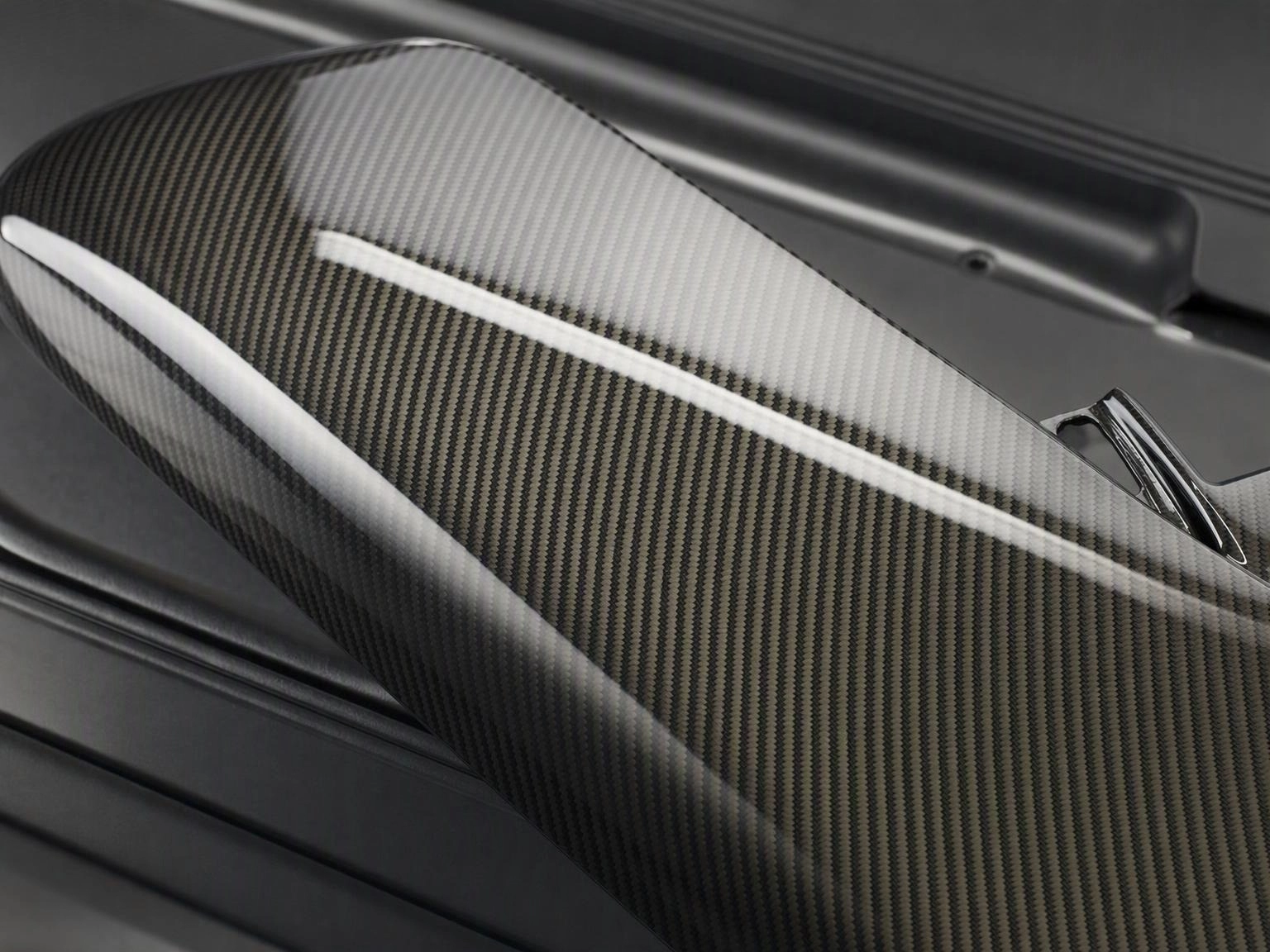
When a customer asks for a “Class A carbon fiber finish”, they usually mean one thing: it must look perfect under the showroom light, with the weave sharp and the surface like glass. Achieving that consistently is one of the hardest things in composites manufacturing, and it is mostly a process problem rather than a materials problem.
What “Class A” means in practice
The term comes from the automotive industry, where it describes an exterior surface with no visible waviness or defects at a defined viewing distance. For a visible carbon part, a workable definition includes:
- No pinholes, dry spots or resin-rich pools in the clear coat.
- Weave pattern straight and undistorted, without tow shifting at corners or radii.
- No print-through of the underlying structure on the cosmetic face.
- Consistent gloss across the part, including edges and tight radii.
- No visible seam or lap line on the primary viewing side.
Each of these traces back to a specific stage in production.
Pinholes: the most common failure
Pinholes are tiny voids in the clear coat, often at weave crossovers where air is trapped between tows. They come from three sources: insufficient vacuum during cure, resin viscosity that is too high to wet out the cloth, and clear coat applied over a surface that was not properly sanded and sealed.
The fix is not “more clear coat”. Building film thickness hides pinholes for a month and then telegraphs them back as the coating shrinks. The durable fix is degassing the resin, controlling the cure ramp, and sealing the surface before topcoat.
Weave distortion and pattern alignment
Carbon cloth does not stretch, so any compound curve either drapes or distorts. On complex geometry, tows fan out at the corners, the pattern shifts, and the part reads as “cheap” even when the structure is sound.
Options, in order of cost: choose a weave with better drape (twill over plain), design the part with gentler curvature, use darts or a seam placed on a hidden face, or switch to a spread tow or forged carbon look where pattern continuity is less critical. For tubes and shafts, the equivalent issue is weave alignment at the joint, which has to be controlled in the wrapping step, not corrected afterwards.
Print-through and the structure beneath
Ribs, honeycomb cores and internal stiffeners show through a thin cosmetic skin as faint ridges once the resin shrinks. This is why cosmetic parts often use a dedicated surface ply separated from the structure, or a syntactic or glass veil layer that equalises shrinkage.
The finishing sequence that delivers gloss
A typical Class A sequence for a pressed or autoclaved carbon part:
- Demold, inspect and record any surface defects before any sanding.
- Sand progressively to remove orange peel and level the surface, without cutting into the weave.
- Apply a primer or sealer coat and cure fully — rushing this step is the usual cause of solvent popping later.
- Apply clear coat, 2K polyurethane or a comparable UV-stable system, in a temperature- and dust-controlled booth.
- Block sand and polish to the specified gloss level.
- Inspect under raking light at the agreed distance, against the approved reference sample.
UV stability deserves a note: epoxy resin yellows in sunlight. A clear coat with UV absorbers is what keeps a carbon part looking black rather than amber after a season outdoors.
Cost and where to spend it
Finishing is labour. On a visible part, surface preparation and polishing can exceed the cost of the laminate itself. The efficient approach is to spend the money where the customer looks: a perfect cosmetic face, a clean but simpler finish on hidden surfaces, and a documented acceptance standard so that both sides agree on what “perfect” means before the first batch.
How Shengtian produces cosmetic carbon parts
Guangdong Shengtian Technology runs an independent dust-free painting workshop for its carbon fiber automotive and lifestyle parts, with controlled temperature and humidity for clear coat application. Pressed and autoclaved parts for engine hoods, spoilers, ashtrays and hard-shell luggage are finished and inspected against sample-approved standards.
If you have a reference finish — a photograph, a physical sample, or a gloss unit target — we will produce a coupon from the production layup for approval before the tool is finalised.
Carbon fiber engine hood · Carbon fiber ashtray · Automotive parts