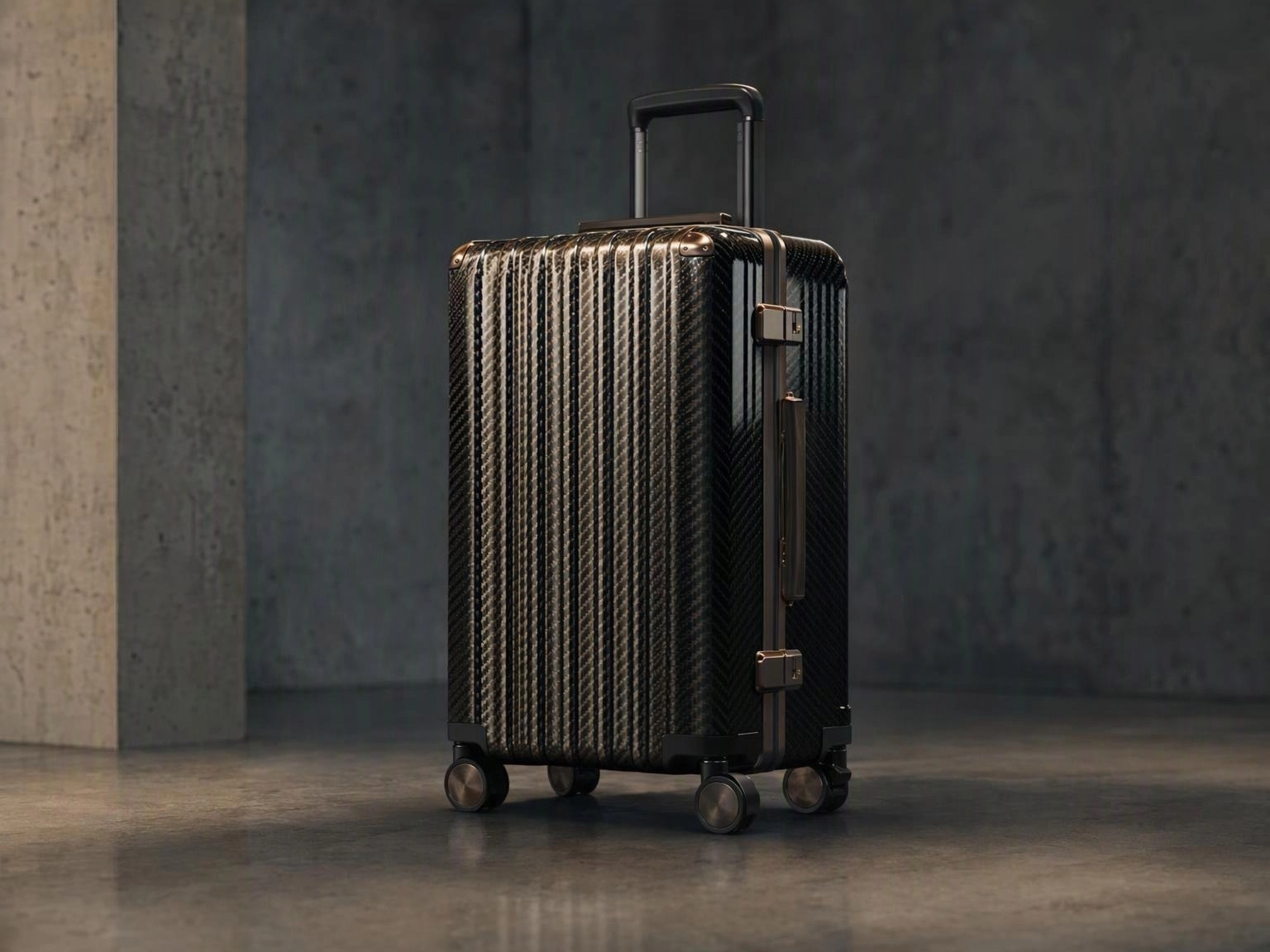
A hard-shell suitcase is one of the few consumer products where a carbon fiber shell genuinely makes sense. The case is a stiffness-limited structure that must protect its contents, survive being thrown by airport handling equipment, and look expensive on a carousel. Composite construction delivers all three — if the details are right.
Shell construction: a monocoque, not a box
Most premium carbon cases are built as a two-part monocoque: front and back shells, each a laminate with a cosmetic outer skin, a structural core and an inner skin. The shells are joined at a hinge and a zipperless seal, and the load path runs through the shell and the frame rather than through an internal chassis.
Layup typically combines a 3K woven cosmetic ply on the outside, unidirectional plies oriented to carry bending loads across the face, and a reinforcement schedule at the corners and wheel mounts, where loads concentrate.
Where cases fail
- Corners. Drop impact drives energy into the corners. Without local reinforcement they crack or delaminate first.
- Wheel mounts. The interface between the shell and the wheel housing takes repeated dynamic loads on rough surfaces. It needs a bonded insert or a locally thickened laminate, not just a bolt through the skin.
- Hinge line. The hinge is a long, straight stress raiser. A poorly bonded hinge will peel along its length after a few hundred cycles.
- Face panel. A large unsupported face will oil-can under pressure or puncture from a sharp corner inside the case.
Ribs and the inner skin
Ribs on the inner face serve two purposes: they stiffen the panel against oil-canning, and they create a load path between the corners, the wheels and the handle. On cosmetic cases the ribs must not print through to the exterior, which is why a veil layer or a local core is often used between the ribbed structure and the cosmetic skin.
Hinge, seal and closure
A zipperless case needs a mechanical seal along the full perimeter. The seal geometry has to be molded or machined accurately, because a gap of a fraction of a millimetre is a water ingress path and a visible defect on a premium product. The hinge must be aligned to the shell halves within a tight tolerance, which is a tooling and fixturing problem rather than a laminate problem.
Handles, wheels and telescopic systems
These are usually sourced components, but their integration determines the durability of the case. The telescopic handle tubes must be anchored into a structural element rather than into a thin cosmetic skin, and the wheel housings should be replaceable, because wheels are the most common wear item on any suitcase.
The tests a serious case should pass
- Drop test: corner, edge and face drops from a defined height with a defined load, repeated.
- Tumbling: a rotating drum test that simulates the baggage handling system.
- Handle and wheel fatigue: thousands of cycles under load.
- Static compression: a load applied to the closed case to check shell stiffness and latch retention.
- Water resistance: spray or immersion, focused on the seal and hinge line.
The results should be documented, not just claimed. For a luggage brand, a test report is a sales asset as much as a quality record.
Cosmetics: why the weave direction matters
On a suitcase, the weave is the product. The pattern should run consistently across both shells, meet cleanly at the split line, and be free of distortion at the corners. Achieving that requires the cosmetic ply to be cut and oriented deliberately, and the tool designed with the pattern direction in mind — not simply draped and hoped for.
How Shengtian builds carbon fiber luggage
Guangdong Shengtian Technology produces carbon fiber hard-shell suitcases as a completed product, covering shell layup, ribbed inner structure, hinge and seal integration, and final assembly, with a dust-free painting workshop for the clear coat that protects the weave from UV and abrasion.
For brands developing luggage, we can supply shells only, shells with frames, or fully assembled cases, depending on how much of the assembly the brand wants to keep in-house.