
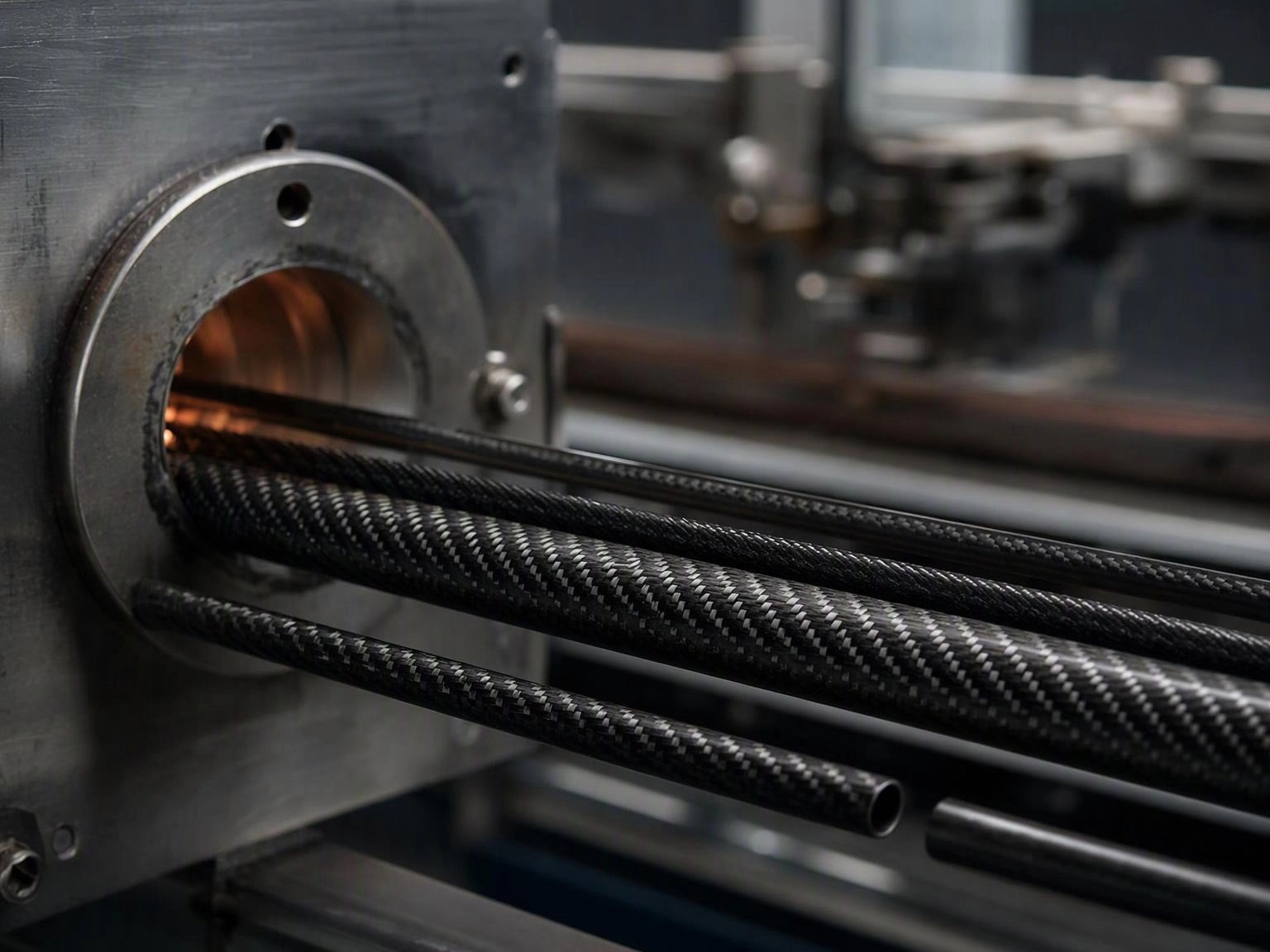
Almost every carbon fiber tube enquiry starts with the same three numbers: outside diameter, inside diameter and length. Those three numbers, however, can be satisfied by at least two completely different manufacturing routes, and the route you choose decides how the finished part performs, how it looks, and what it costs at volume.
This article compares the two processes used most often for carbon fiber and fiberglass tubes — pultrusion and roll-wrapping — from the point of view of a design engineer or sourcing manager specifying a part for the first time.
What pultrusion actually does
In pultrusion, dry fiber tows are pulled continuously through a resin bath and then through a heated steel die that sets the cross-section. The result is a constant-profile part: rod, round tube, square tube, flat strip or a custom profile, produced in long runs and cut to length afterwards.
Because the fibers are pulled in a straight line and held under tension, pultruded tube is highly efficient in the axial direction. Fiber volume fraction is typically higher than in hand processes, void content is low, and the process is repeatable enough that wall thickness can be held within a tight band once the die is stable.
- Best for: straight structural members under tension or bending — drone arms, tripod legs, tent poles, tool handles, frame spacers, insulating rods.
- Strength direction: dominated by 0° axial fibers. Hoop strength is comparatively low unless a woven or braided layer is added.
- Tooling: one die per cross-section. Cost is amortised over long runs, so pultrusion becomes very economical above a few thousand meters.
- Finish: a smooth die-formed surface, usually with a visible axial fiber line rather than a woven cosmetic pattern.
What roll-wrapping does
Roll-wrapping starts from pre-impregnated carbon fiber sheet. The prepreg is laid on a steel mandrel, wrapped under tension to build the required wall thickness, then cured — often under heat shrink tape in an oven — and finally the mandrel is extracted.
Because the material is a flat sheet wrapped around the axis, the fibers follow the circumference rather than the length. That single fact changes the mechanical behaviour: roll-wrapped tube is excellent in hoop direction and pressure resistance, and it is the natural route for anything that needs a woven cosmetic surface.
- Best for: visible parts and products where appearance sells — billiard cue shafts, trekking poles, bicycle tubes, drone booms with a 3K twill finish, cosmetic housings.
- Strength direction: strong in hoop and torsion. Axial stiffness depends on the layup angle, so a 0/90 layup can be used where bending stiffness matters.
- Tooling: mandrels are much cheaper than pultrusion dies, which makes roll-wrapping viable from a few hundred pieces.
- Finish: the weave is visible through the resin, gloss level can be controlled from matte to mirror, and coloured or 3K patterns are easy to achieve.
The comparison that matters in a quotation
When both processes can make the same nominal tube, the decision usually comes down to four trade-offs:
- Stiffness per gram. If the part is a straight beam and cosmetics do not matter, pultrusion usually wins: more axial fiber for the same weight.
- Cosmetics. If the customer will see the part, roll-wrapping wins. A pultruded tube can be painted, but reproducing a deep 3K weave is not practical.
- Wall tolerance. Pultruded wall is set by the die and is consistent along the length. Roll-wrapped wall is built layer by layer, so tolerance depends on ply count and mandrel control.
- Volume and length. Continuous pultrusion suits long lengths and high volume. Roll-wrapping suits shorter lengths, thicker walls and mixed SKUs.
Where the two processes overlap
Many products actually need both behaviours. A drone arm may need axial stiffness for flight loads and hoop strength at the motor mount; a trekking pole needs bending stiffness in the shaft and crush resistance at the locking joint. In these cases the practical answer is often a hybrid: a pultruded core with a wrapped cosmetic or hoop layer, or a roll-wrapped tube with a percentage of 0° plies.
That is a conversation worth having with the factory before drawings are frozen, because the layup sequence affects both price and the minimum order quantity.
How Shengtian approaches tube specification
Guangdong Shengtian Technology operates both pultrusion and roll-winding lines under one roof, producing carbon fiber and fiberglass rods, round tubes, square tubes and custom profiles. Because both routes are in-house, the recommendation is based on the application rather than on which machine happens to be free. Typical inputs we ask for are the load case, the cosmetic requirement, the operating temperature and the annual quantity — from those, the process and layup can be proposed together with a realistic tolerance band.
If you are still at the stage of comparing options, send a drawing or even a sketch with the target dimensions and we will come back with the recommended process, a sample plan and an indicative price for both routes.
Carbon fiber rods · 3K roll-wrapped tubes · Carbon fiber square tubes