
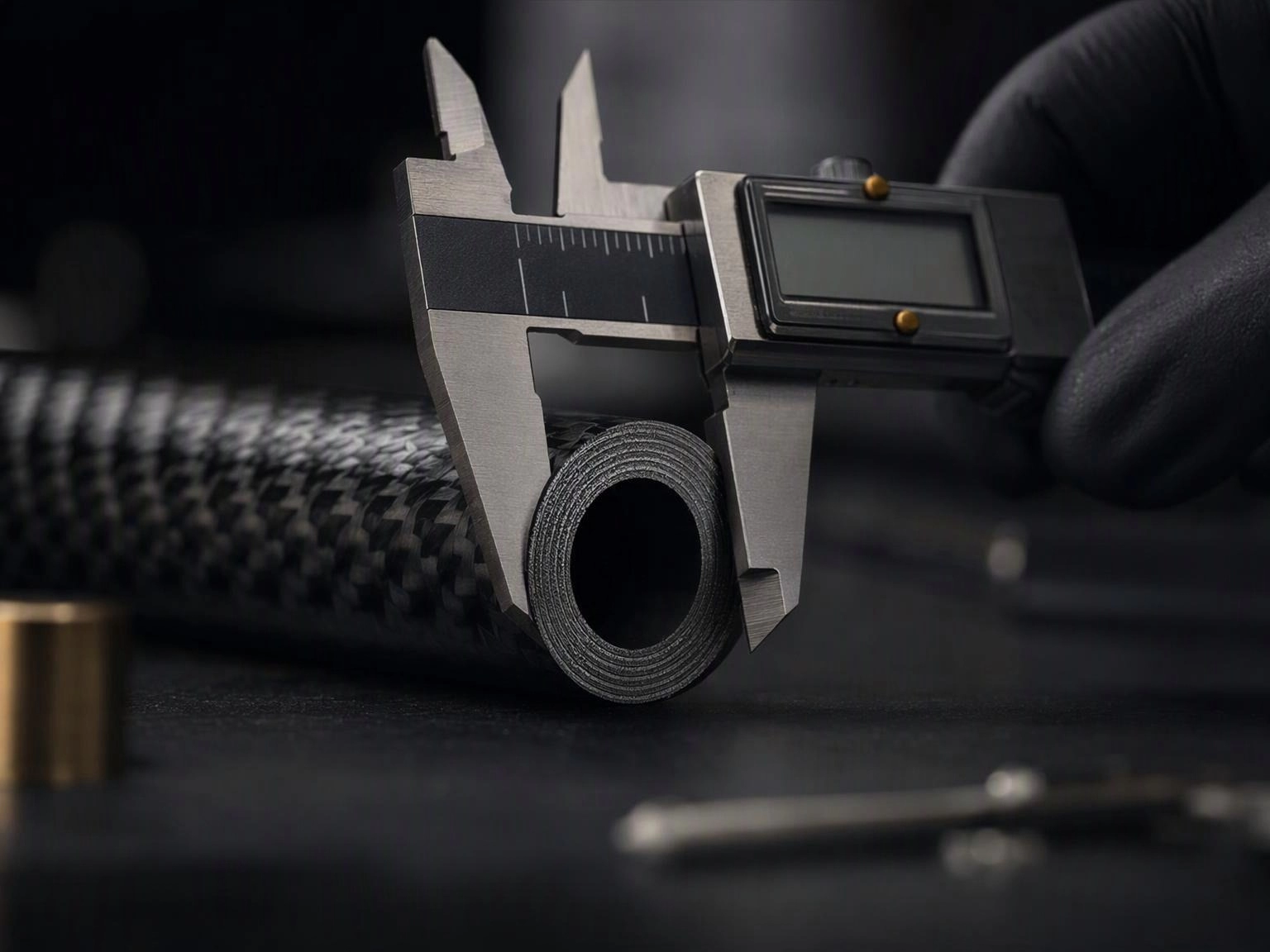
A carbon fiber tube looks like a simple part on a drawing: outside diameter, inside diameter, length. In production, those dimensions describe a family of parts with very different mechanical behaviour and very different prices. Two tubes that both measure 25 × 23 mm can differ by a factor of two in bending stiffness depending on how the fibers are oriented, and by a similar factor in cost depending on how the wall is built.
The following checklist is the one we walk through with customers before quoting a custom tube. It is written for design engineers, product managers and sourcing teams who need a part that works the first time.
1. Start from the load, not from the dimension
The most useful information you can give a tube manufacturer is how the part is loaded. A boom that carries a bending moment, a shaft that transmits torque, a spacer that only carries compression and a handle that gets crushed in a clamp are four different designs even if they share a diameter.
- Bending: axial (0°) fibers do the work. Pultrusion or a 0°-dominant layup is efficient.
- Torsion: ±45° plies carry shear. A roll-wrapped tube with angled plies outperforms a straight pultrusion of the same weight.
- Hoop / crushing: 90° fibers are required. Thin-wall pultruded tube can ovalise under clamp load; a hoop layer or a local reinforcement solves it.
- Impact: woven surface layers spread point loads and reduce delamination visibility.
2. Decide the wall thickness from stiffness and from handling
Wall thickness drives both stiffness and robustness. Two practical notes from production:
First, stiffness rises roughly with the cube of diameter but only linearly with wall thickness. If a tube is not stiff enough, increasing diameter is usually more efficient than thickening the wall — as long as the envelope allows it.
Second, very thin walls are a handling and assembly risk. A wall under about 0.8 mm in a 20 mm tube dents easily during shipping, clamping or press-fitting. For consumer products we often recommend a slightly thicker wall than pure structural calculation requires, because the failure mode in the field is almost never the calculated load.
3. Choose the layup and be explicit about direction
“Carbon fiber” alone is not a specification. The same fiber and resin can be laid up as unidirectional, 3K twill woven, spread tow, or a multi-axial stack. On a drawing, state:
- Fiber type and grade if it matters (standard modulus vs. high modulus, T700/T800 class).
- Weave or architecture for cosmetic surfaces, including the direction of the pattern.
- Nominal fiber volume fraction or wall build-up, if the part is structural.
- Which surface is cosmetic and which is hidden — this alone can change the process.
4. Set tolerances you can actually inspect
Tolerance is where drawings and reality most often diverge. A few rules that save time in qualification:
- OD: ±0.1 mm is routine for ground or die-formed tube; ±0.05 mm requires post-machining and should be reserved for bearing seats or sliding fits.
- ID: the inside of a roll-wrapped tube is defined by the mandrel, so ID tolerance is usually tighter than OD. If a mating part inserts into the tube, specify ID as the controlling dimension.
- Wall: specify as a minimum rather than a nominal where strength matters, so that a thin spot cannot pass inspection.
- Straightness: state it as mm per meter. Long thin tubes bow during cure and during storage; a realistic callout avoids rejected shipments.
- Length: ±1 mm is normal for cut tube; ±0.2 mm implies a secondary machining operation.
5. Say what the surface must survive
Surface requirements are frequently left off the drawing and then become the reason a batch is disputed. Clarify whether the tube will be painted, bonded, printed, handled daily or exposed to UV and salt spray. A clear gel coat, a matte lacquer and a raw sanded surface are three different products at three different price points, and only one of them will look correct in the customer's hands.
What a good RFQ looks like
The fastest quotations we issue contain a drawing, an annual quantity, a description of the load, the cosmetic requirement and the mating parts. When any of those is missing, we ask — because guessing is how a sample passes and a production batch fails.
Guangdong Shengtian Technology produces pultruded and roll-wrapped carbon fiber tubes, rods and profiles with in-house tooling, machining and finishing, and works from prototype quantities through to container-level volumes. Send your drawing and we will return a specification review with the tolerances we can hold and the price at each volume tier.