
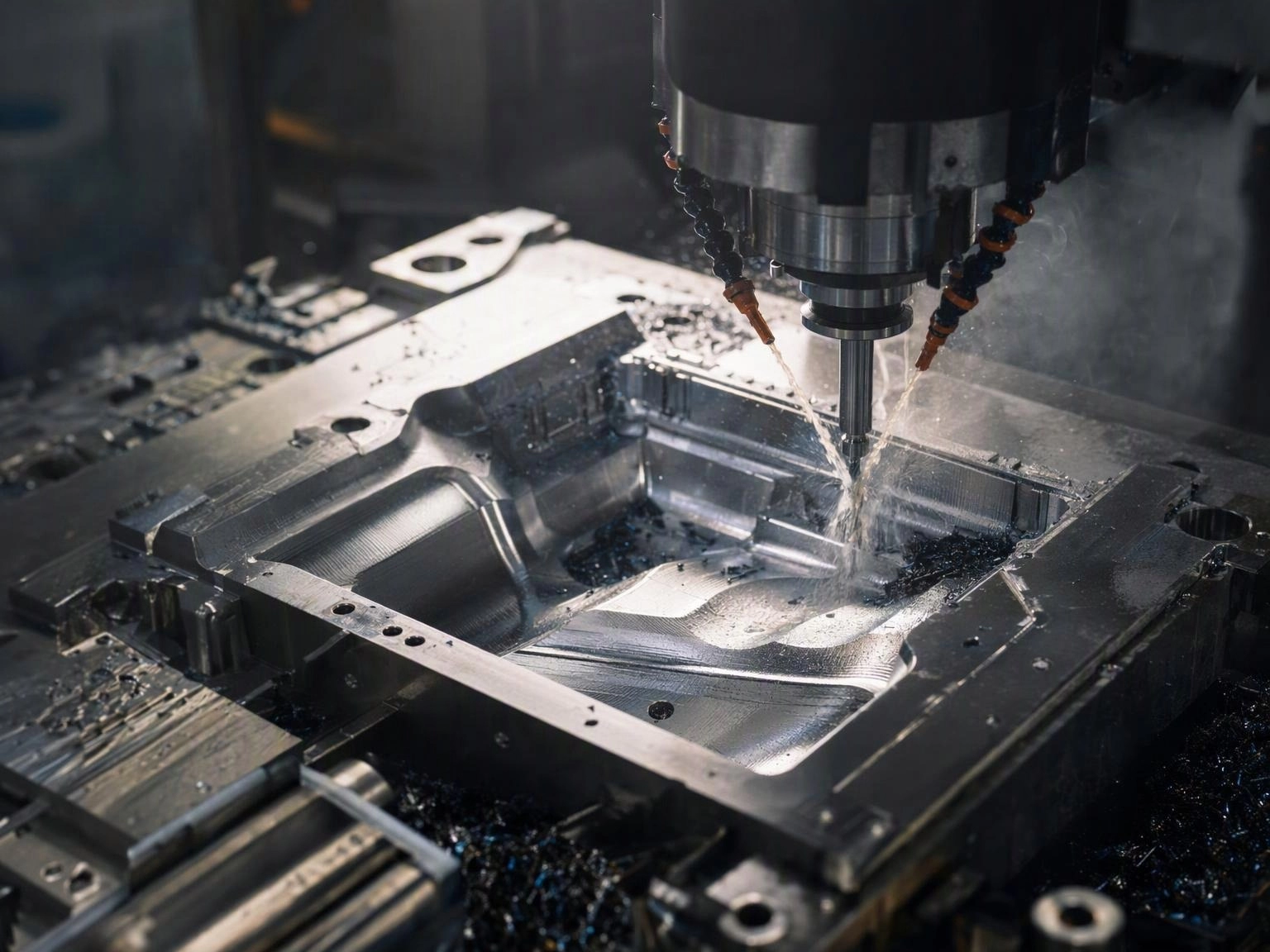
In composites, the tool is the product. Wall thickness, surface finish, parting line position, insert location and dimensional repeatability are all determined by the mold, not by the operator. Once steel is cut, changing a decision costs an order of magnitude more than changing it on a drawing.
This checklist is the conversation we have with customers before releasing a tool, and it applies equally to compression molds, autoclave tools and roll-wrapping mandrels.
Geometry: the five decisions that cause most rework
- Draft angle. Composite parts need draft to release, and the amount depends on surface texture and depth. Insufficient draft produces scuffed parts and damaged tools; two degrees is a reasonable starting point for a smooth cosmetic surface, more for textured or deep cavities.
- Radii. Sharp inside corners concentrate stress and are difficult to fill without voids. A minimum inside radius of 3 mm, and preferably 5 mm, avoids both problems.
- Wall uniformity. Abrupt thickness changes create resin-rich or resin-starved zones and cure gradients. Transition gradually, ideally over a length of several times the thickness difference.
- Parting line placement. On a cosmetic part, the parting line should sit on a hidden face or along a natural edge. Deciding this after the tool is built is how visible seams end up on the front of a product.
- Demold direction. Undercuts require slides or collapsible tooling, both of which add cost and maintenance. Where possible, redesign the feature out.
Tolerances: what the process can actually hold
Different processes hold different tolerances, and asking for more than the process can deliver adds cost without adding quality:
- Pultruded profiles: cross-section is set by the die and is very repeatable; length is cut to order.
- Roll-wrapped tubes: inside diameter is set by the mandrel and is typically the tighter dimension; outside diameter depends on wall build-up.
- Compression molded parts: mold-defined features are repeatable, but warpage on large flat parts must be allowed for.
- Autoclave parts: dimensionally accurate but subject to spring-back on thin, curved geometry.
The practical rule: identify the two or three dimensions that are functionally critical and tolerance them tightly; leave the rest at general tolerance. A drawing where everything is ±0.05 mm is a drawing that will be quoted high and inspected slowly.
Inserts and interfaces
Metal inserts are where composite parts most often fail in service. Decide early:
- Which fasteners carry load, and in which direction.
- Whether inserts are molded in, bonded in, or installed after cure.
- How galvanic isolation is achieved where carbon meets aluminum.
- What the pull-out and torque requirements are, and who tests them.
Molding an insert into a compression part is cheap and strong. Drilling and bonding an insert into a cured tube is expensive and depends entirely on surface preparation, which is the least controllable step in any bonded joint.
Cosmetics: decide the standard before the tool
For visible carbon parts, the tool determines the achievable finish. A mold polished to a mirror finish supports a Class A clear coat; a mold with tool marks will telegraph through. Decide:
- Which surfaces are cosmetic and which are hidden.
- Whether the weave pattern must align to a specific edge or axis.
- Acceptable weave distortion at corners and radii.
- Gloss target, colour reference and the inspection lighting condition.
Agreeing a physical master sample at tooling stage prevents the classic argument at first article, where the factory and the customer are looking at the same part and disagreeing about whether it is acceptable.
Tooling material and life
Prototype tools in MDF or aluminum are cheap and fast but have a short life and lower dimensional stability. Production tools in steel or invar cost more but hold tolerance over hundreds of thousands of cycles. The right choice depends on volume and on how much the part's cosmetics matter — a production tool for a visible part is worth the investment because the surface finish is what the customer buys.
Validation before full production
Before committing to a full run, confirm: first article dimensional report against the drawing, material and cure records, a cosmetic sample approved against the master, and at least one destructive or sectioned part to verify wall thickness and void content where it matters. This is a small cost that prevents a very large one.
How Shengtian handles tooling
Guangdong Shengtian Technology designs and builds tooling in-house for pultrusion, roll-winding, compression molding and autoclave processes, which means DFM feedback arrives before the tool is cut rather than as a change request afterwards. Our engineers review draft, radii, parting lines, insert strategy and cosmetic standards as part of the quotation, and produce a sample coupon from the production tool for approval where appearance is critical.
Send a 3D model or a drawing and we will return a DFM review with the tolerances we can hold and the tooling cost at your volume.