
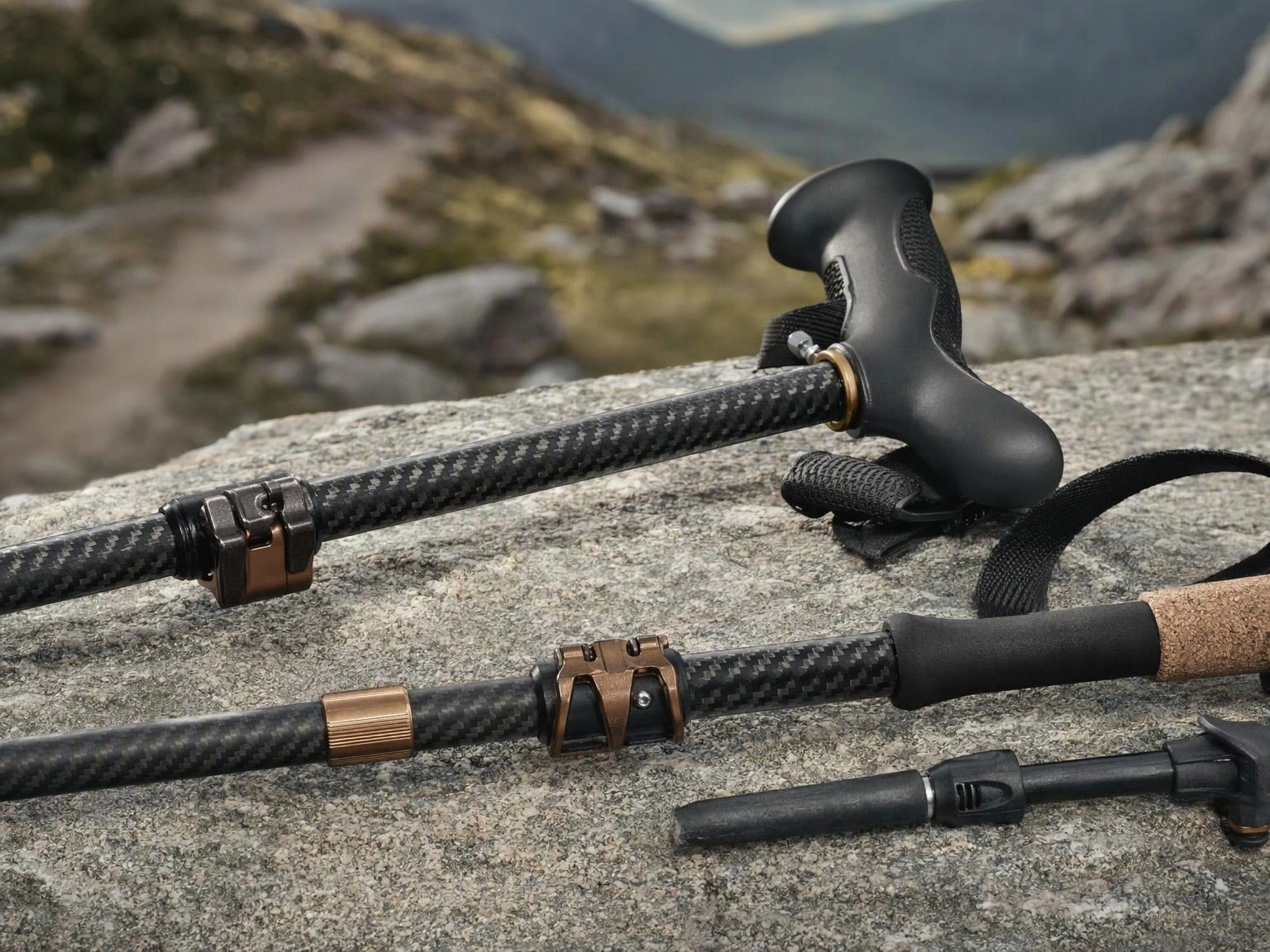
Walking aids are a deceptively demanding application for composites. A trekking pole sees bending from an off-axis plant, compression along its length, torsion during adjustment, and repeated point impact at the tip. A walking cane sees a large fraction of body weight applied off-centre, every step, for years.
The result is that a pole which passes a static load test can still fail in the field if the design does not account for the real load path.
The governing failure modes
- Bending at the mid-span. The most common failure in trekking poles, usually from a plant on uneven ground or a stumble. Bending stress scales with distance from the load, so the lower section is usually the critical one.
- Local buckling and ovalisation. Thin-wall tube in compression can buckle before the material reaches its strength. Wall thickness and diameter ratio govern this.
- Joint crush. The locking joint is the weak point. Over-tightening the clamp collapses the tube; under-tightening allows slip and fretting.
- Tip impact and rock strikes. Point loads at the tip and along the lower shaft create local damage, which then propagates under cyclic load.
- Fretting at the joint. Repeated small movements between the inner and outer tube wear the surface, reducing wall thickness exactly where stress is highest.
Wall thickness: the safety-critical decision
Marketing pushes for lighter poles, which pushes wall thickness down. There is a floor below which the part becomes fragile in normal use, regardless of what a static test says. In practice, a wall thick enough to resist clamp crush at the joint and to survive a rock strike is usually thicker than a pure bending calculation would suggest.
Where weight really comes off is elsewhere: thinner walls in the upper sections that carry less bending moment, a taper that follows the stress distribution, and elimination of metal fittings that are over-specified for the load.
Taper and the stress distribution
A tapered shaft puts material where the bending moment is highest and removes it where it is not. That is why high-quality poles are tapered rather than constant-diameter. The taper must be gradual: an abrupt change in section creates a stress concentration and a place for cracks to start.
Taper also affects the locking joint. A tapered joint can be self-locking under load, which is more reliable than a pure friction clamp but harder to release. The choice depends on the user group — trekking poles favour quick release, canes favour a permanently locked assembly.
Canes: a different load case
A walking cane carries a significant fraction of body weight, often applied eccentrically, with a lateral component from the user's gait. Safety factors must reflect the consequences of failure, which for a cane used by an elderly user are severe.
Practical design rules for canes: keep the wall thicker than on a trekking pole, use a larger diameter for stiffness rather than a thicker wall for strength, terminate the tube in a properly bonded handle rather than a clamped one, and specify a non-marking tip with a defined compression set so the pole does not slip on wet surfaces.
Designing the joint properly
The joint deserves more engineering attention than the shaft. Good practice includes:
- A reinforced section at the clamp area — either a locally thicker wall, an internal sleeve or a bonded ferrule.
- A clamp that distributes load over at least two diameters, rather than a single narrow ring.
- Deburred, chamfered tube ends: a sharp edge is a crack initiator and also damages the mating tube.
- An anti-rotation feature if the pole carries a strap or a specific grip orientation.
Colour, finish and brand differentiation
In consumer products the visible surface is part of the specification. Coloured 3K tubes, gloss or matte lacquer, printed logos and grip interface finishes all affect perceived quality. They also affect durability: a thin decorative lacquer will wear through at the grip and clamp within a season, so coating thickness and adhesion testing matter as much as colour matching.
How Shengtian produces poles and canes
Guangdong Shengtian Technology roll-wraps 3K and coloured 3K carbon fiber tubes and finishes complete trekking poles, hiking poles and walking canes, including tapered shafts, locking joints and grip interfaces. Because the same factory produces the tubes, machines the tapers and applies the finish, the wall thickness at the joint can be controlled deliberately rather than inherited from a catalogue tube.
For new products we recommend starting from the load case and the user group, then deriving wall, taper and joint design — rather than starting from a target weight and discovering the safety margin afterwards.
Carbon fiber trekking pole · Colourful carbon fiber trekking pole · Carbon fiber walking cane