
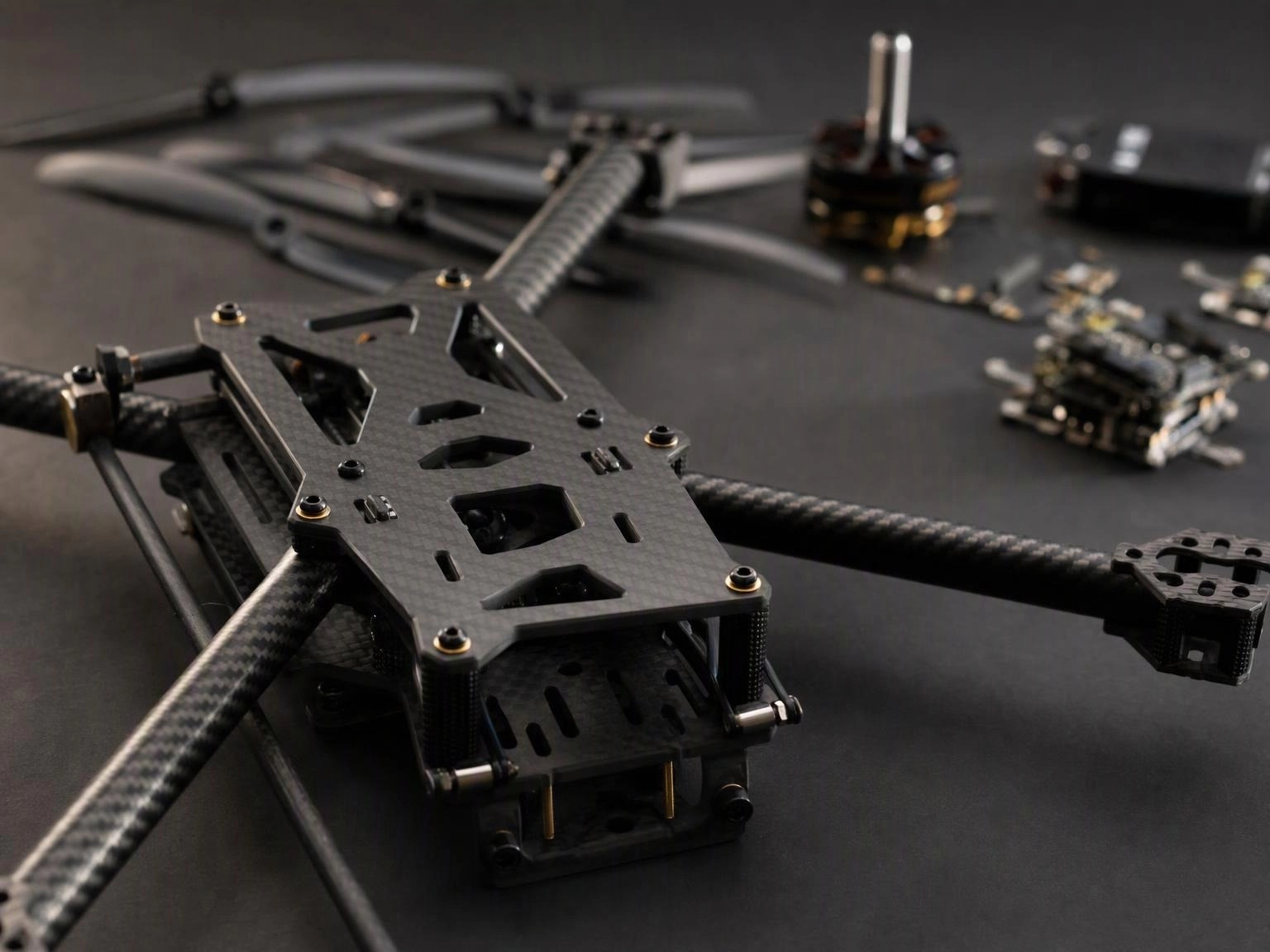
Ten years ago a serious multirotor frame was likely to be aluminum or glass fiber. Today, from a 5-inch FPV racer to a multi-hour inspection UAV, carbon fiber tube and plate dominate the structure. The reasons are not purely about weight — they are about stiffness, vibration and the way a frame fails.
Stiffness is a flight characteristic, not a specification
A drone frame is a stiffness problem disguised as a weight problem. Arm deflection changes motor alignment; motor misalignment costs thrust efficiency and produces yaw trim that the flight controller must fight continuously. Frame resonance interacts with gyro filtering and can make a tune impossible to stabilise. A stiffer arm raises the first bending mode above the frequencies the flight controller needs to control.
Carbon fiber tube delivers that stiffness at a fraction of the mass of an aluminum tube of equal deflection. In practice this means longer arms for the same all-up weight, larger props, and better wind penetration — the three things that most directly extend flight time and control authority.
Vibration damping: the underrated advantage
Composites damp vibration far better than metal. Aluminum rings; a carbon tube dissipates energy internally. On a camera platform this shows up as cleaner video and higher usable gyro gain. On an industrial UAV carrying a gimbal or LiDAR, it shows up as less jitter in the payload data and fewer fatigue issues at bolted joints.
Where aluminum still appears — and why
Few high-performance frames are pure carbon. Motor mounts, landing gear and folding mechanisms are commonly machined aluminum because they need threads, tight bearing fits and multi-axis geometry that a tube cannot provide. The result is a bonded or clamped hybrid: carbon tube for the span, aluminum for the interfaces. Managing that joint well is the difference between a frame that lasts a season and one that delaminates at the clamp.
Five tube parameters that decide frame quality
- Wall thickness. Thin walls save grams but crush at clamp loads. A 0.5 mm wall in a 25 mm tube will ovalise under a typical motor mount bolt torque unless a reinforcement sleeve is used.
- Fiber architecture. Pultruded tube gives the best axial stiffness per gram; a hoop layer or a roll-wrapped ±45° layup improves clamp and crash resistance.
- Straightness. Bowed arms put the motor out of plane and cost efficiency. Specify mm per metre, not “straight”.
- Cut quality. A frayed or delaminated cut end is a crack initiation site. Machined ends with chamfers are worth the small extra cost.
- Surface. Sanded matte for bonded joints (adhesive needs a keyed surface); gloss for cosmetic products. Never bond to a release-agent-contaminated gloss surface.
FPV versus industrial: different priorities
FPV racing frames prioritise crash tolerance and repairability. They tend to use thicker walls, square or flattened arm profiles, and replaceable arm tubes. Industrial UAVs prioritise stiffness, weather resistance and consistency across a production run: the same frame must fly identically in unit 1 and unit 500, which places the emphasis on process control and documented inspection rather than on ultimate strength.
Both segments increasingly ask for tighter tolerance rather than higher strength, which is a manufacturing question more than a materials question.
Designing the joint, not just the tube
Most drone frame failures start at a hole or a clamp, not in the middle of the span. Practical guidance our engineering team gives UAV customers:
- Avoid drilling through the tube wall where possible; use clamping collars that spread load over a length of at least two diameters.
- Where bolts must pass through, add an internal sleeve or a bonded insert and specify a generous edge distance.
- Do not clamp carbon directly against aluminum without an isolating layer if the assembly will see moisture; galvanic corrosion will loosen the joint over time.
- Keep the tube ends sealed. An open tube wicks moisture and, in cold climates, freeze-thaw cycling can delaminate the wall.
How Shengtian supports drone manufacturers
Guangdong Shengtian Technology produces pultruded carbon fiber rods and square tubes, roll-wrapped 3K round tubes and precision-cut arm assemblies for UAV and FPV applications, with tolerances and cut finishes specified per frame design. Because the same factory also presses carbon fiber plates and machines aluminum interfaces, a frame can be sourced as a matched set rather than assembled from three suppliers with three tolerance stacks.
Tell us your arm length, motor mount pattern and target all-up weight, and we will propose a tube specification and a joint concept that can be prototyped quickly.
Carbon fiber square tubes · Carbon fiber rods · 3K roll-wrapped tubes