
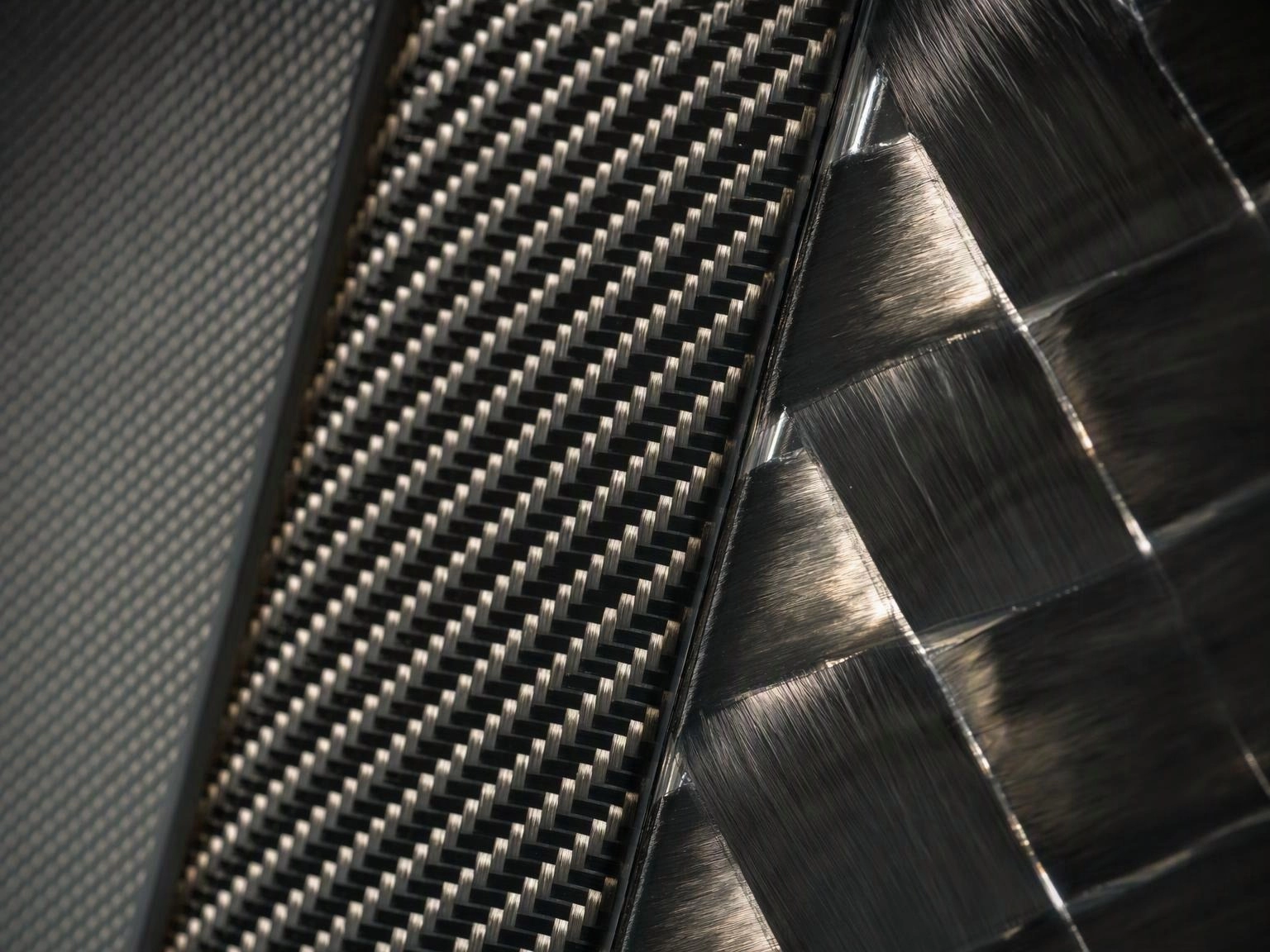
In quotations and product listings, carbon fiber is frequently described by a single figure: 3K. The number is shorthand for the tow size — how many individual filaments are bundled into one roving. It is a useful shorthand, but it controls only part of what the customer actually sees and feels, and confusing it with quality is a common and expensive mistake.
What the number means
A tow is a bundle of continuous carbon filaments. 1K means roughly one thousand filaments per bundle, 3K three thousand, 12K twelve thousand, and so on. The individual filament diameter is on the order of seven microns regardless of tow size — what changes is how many of them travel together.
When that tow is woven into cloth, the bundle size sets the visual scale of the weave. A 1K cloth produces a fine, dense, almost silk-like pattern. A 3K cloth produces the familiar “carbon look” with clearly visible tow blocks. A 12K cloth produces a much larger, bolder pattern and is significantly cheaper per square meter because fewer, larger tows are handled.
Twill, plain and spread tow
Tow count is only half of the appearance equation; the weave architecture is the other half.
- Plain weave: one-over-one. Tight, stable, symmetric, minimal drape. Good for flat panels and thin parts, and it holds shape well on complex tooling.
- Twill weave: two-over-two, producing the diagonal rib pattern most people associate with carbon fiber. Better drape than plain weave, and the dominant choice for cosmetic tubes and tubes with compound curvature.
- Spread tow: large tows are flattened into wide, thin tapes before weaving. The result is a very flat, low-porosity surface with a large checkerboard pattern, popular in high-end sporting goods and automotive trim.
Why a bigger tow is not automatically better or worse
Larger tows reduce weaving and handling cost, and they can be laid faster in pultrusion and tape-laying processes. But they also produce thicker, less drapeable fabric, more pronounced crimp at weave intersections, and a coarser surface that is harder to finish to a mirror gloss. For very thin walls, a 12K cloth may be impossible to form around a small radius without fiber distortion.
Conversely, 1K cloth looks refined but costs more and is available in fewer weights; for structural parts it adds cost without adding stiffness, because stiffness comes from the fiber areal weight and orientation, not from the tow size.
The practical specification checklist for a cosmetic part
If the goal is a specific appearance — matching a reference sample, a competitor product or a brand guideline — specify all five of these, not just the tow count:
- Tow size and weave: for example “3K twill, 200 g/m²”.
- Pattern direction and alignment: where the diagonal chevron should point on a tube or panel, and whether a centre seam is acceptable.
- Resin system and gloss level: matte, satin or high gloss; clear, tinted or pigmented.
- Colour: natural black, or a coloured 3K fabric where the product needs a brand colour.
- Reference sample: a photo under neutral light, or a physical sample, beats any written description.
Colour and the “black” that is not black
Natural carbon fiber is a very dark grey with a slight sheen, not a true black. Under bright light the weave reads as charcoal, which is why cosmetic parts are often finished with a tinted clear coat or a black primer beneath the lacquer to deepen the appearance. Coloured 3K fabrics — red, blue, gold, silver — are produced by colouring the fiber or the binder, and they behave slightly differently in processing, so they should be sampled rather than assumed.
How Shengtian handles cosmetic laminates
Guangdong Shengtian Technology roll-wraps 3K and coloured 3K tubes for billiard cues, trekking poles, walking canes and cosmetic housings, and presses 3K cosmetic skins onto automotive parts and lifestyle products. For colour-critical projects we produce a physical sample coupon from the actual production layup and send it for approval before the batch starts, because screen colour and real laminate appearance rarely match.
If you have a reference product in hand, send a photo or a sample and we will identify the tow size, weave and finish that reproduces it.
Colourful 3K carbon fiber tubes · 3K roll-wrapped tubes · Carbon fiber sheets