
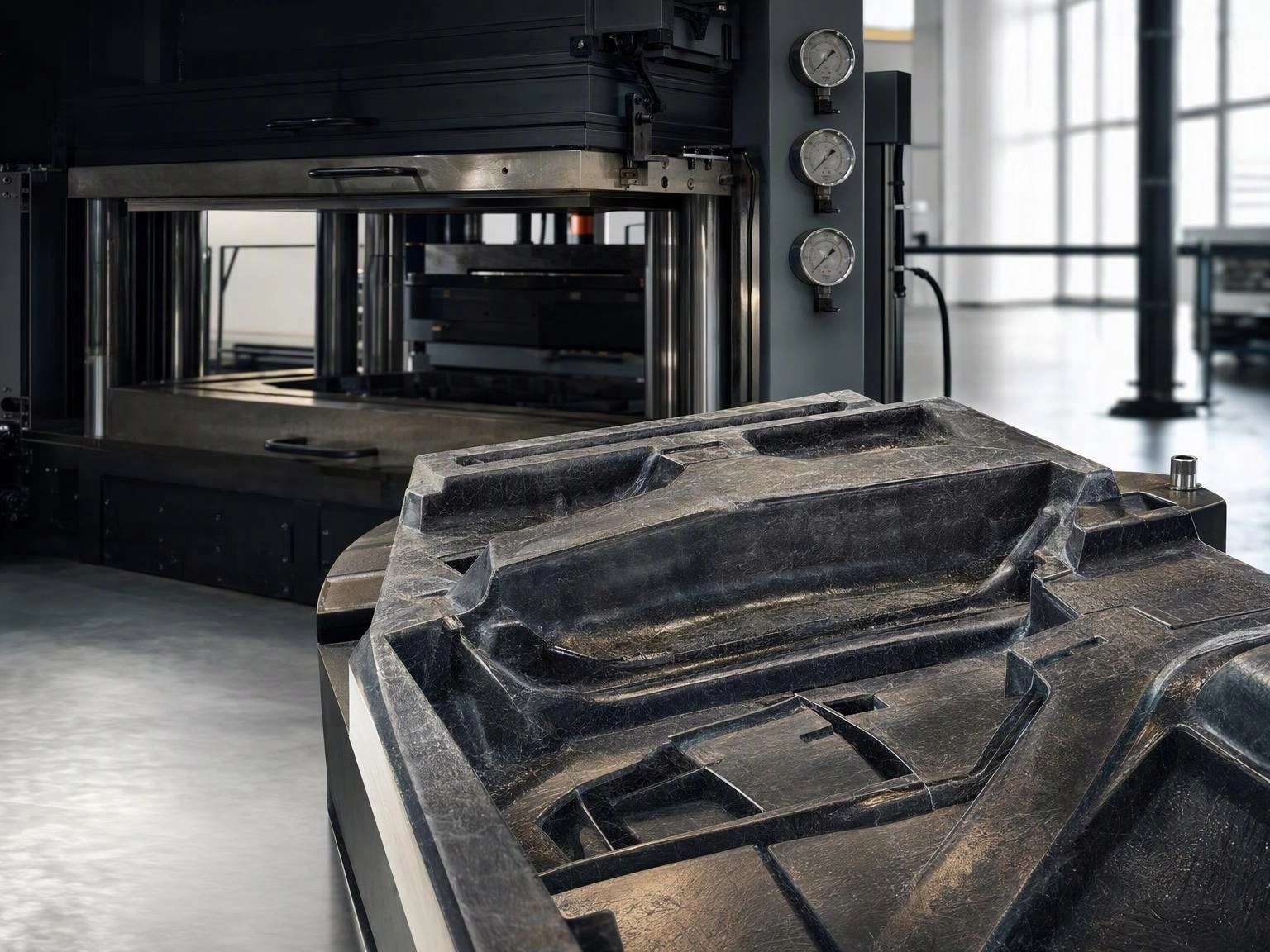
Fiberglass and composite parts reach the market through several production routes, and the choice is usually made early — often before the product design is frozen. Get it wrong and the part is either too expensive to sell or cannot meet the surface and tolerance the product needs.
This article compares the three routes we are asked about most: SMC compression molding, BMC injection molding, and hand lay-up with polyester or epoxy.
Hand lay-up: flexible, cheap to start, expensive to scale
Hand lay-up (and its relatives, spray-up and vacuum bagging) uses an open mold. Fiberglass mat or cloth is placed in the mold, resin is applied by hand or spray, and the part cures in the open air or under vacuum.
The advantage is that tooling is inexpensive — often a fraction of a matched metal mold — so it is the right route for prototypes, large one-off shapes, boat hulls, architectural elements and low-volume custom work. The disadvantages appear at volume and on the visible surface: part-to-part variation is high, labor content dominates cost, the surface usually needs gel coat and fairing, and both faces of the part are not equally well defined.
SMC: matched molds for repeatable, two-sided parts
Sheet Molding Compound is a pre-mixed sheet of chopped glass fiber, resin and filler, matured to a workable consistency. It is cut and placed in a heated matched metal mold, then compressed at high pressure until it flows to fill the cavity and cures.
What this buys:
- Two good surfaces. Both faces take the mold finish, unlike hand lay-up where only the gel coat side is cosmetic.
- Repeatability. Wall thickness, rib geometry and inserts are set by the tool, so unit 1,000 matches unit 1.
- Integrated features. Ribs, bosses, metal inserts and mounting points can be molded in, eliminating secondary operations and fasteners.
- Speed. Cycle times for medium parts are measured in minutes, not hours.
The trade-off is tooling: a hardened steel mold is a significant investment and only pays back at a few thousand parts. SMC also has practical limits on how thin and how sharply detailed a part can be, and the chopped fiber gives good but not directionally optimised strength.
BMC: for thick, complex, highly detailed parts
Bulk Molding Compound is the same family of material in a putty-like form, which allows it to be injected or transfer-molded rather than compression-molded from a sheet. It flows better into deep, intricate cavities and around inserts.
This makes BMC the natural choice for electrical enclosures, pump housings, switchgear components, valve bodies and parts with deep ribs or many small features. It also handles thicker sections more gracefully than SMC, which prefers a more uniform wall.
The comparison that decides a project
- Annual volume. Below roughly 500 parts, hand lay-up usually wins on total cost. Above several thousand, matched-die molding wins decisively.
- Cosmetic requirement. One visible face only: hand lay-up is viable. Two visible faces, tight parting lines, molded-in texture: SMC or BMC.
- Dimensional tolerance. Loose tolerance and large parts favour open molding. Repeatable tolerance with inserts favours compression molding.
- Part complexity. Deep ribs, bosses and many inserts point to BMC. Large, relatively flat, structural panels point to SMC.
- Material performance. Neither process delivers the directional stiffness of continuous carbon fiber. If the part is stiffness-critical, the answer is a different process entirely.
Surface finish: the question that hides in every RFQ
Buyers often ask for a “Class A” surface without defining what it means for their product. In SMC, mold quality, compound formulation and molding parameters all affect surface waviness, porosity and paint adhesion. A mold polished for a visible exterior panel is a different tool from one built for a hidden structural part, and the price difference is real.
The practical approach is to agree on a reference sample and a defect acceptance standard before the tool is cut. That single step prevents most of the disputes that occur at first article inspection.
Where Shengtian fits
Guangdong Shengtian Technology operates SMC compression molding and BMC molding alongside pultrusion, roll-winding, carbon fiber pressing and autoclave curing. That range matters when a product family spans several requirements — for example a construction component molded in SMC paired with a pultruded reinforcing profile, or an enclosure in BMC with a carbon fiber cosmetic cover.
Our SMC FRP waffle box molds are a good example of the process applied to construction: reusable formwork that survives repeated casting cycles, with molded-in ribs and a dense, concrete-release-friendly surface. We are happy to review a part drawing and recommend the route with the lowest total cost at your volume.