Carbon fiber has an uncomfortable sustainability profile: it is energy-intensive to make, almost impossible to recycle back into the same fiber, and mostly ends up in landfill at end of life. Customers, regulators and brand owners are starting to ask about it, and suppliers are starting to answer.
This article separates what is technically established from what is marketing, so that a buyer can ask the right questions.
Why virgin carbon fiber is hard to recycle
Carbon fiber is made by carbonising a precursor at high temperature, which is where most of the energy and most of the cost sit. The fiber is then embedded in a thermoset resin — typically epoxy — which cross-links permanently and cannot be re-melted. Recycling therefore has to break down the resin without destroying the fiber.
Two routes dominate: pyrolysis (burning off the resin at high temperature in the absence of oxygen) and solvolysis (dissolving the resin chemically). Both recover the fiber, and both degrade it to some degree.
What recycled carbon fiber can and cannot do
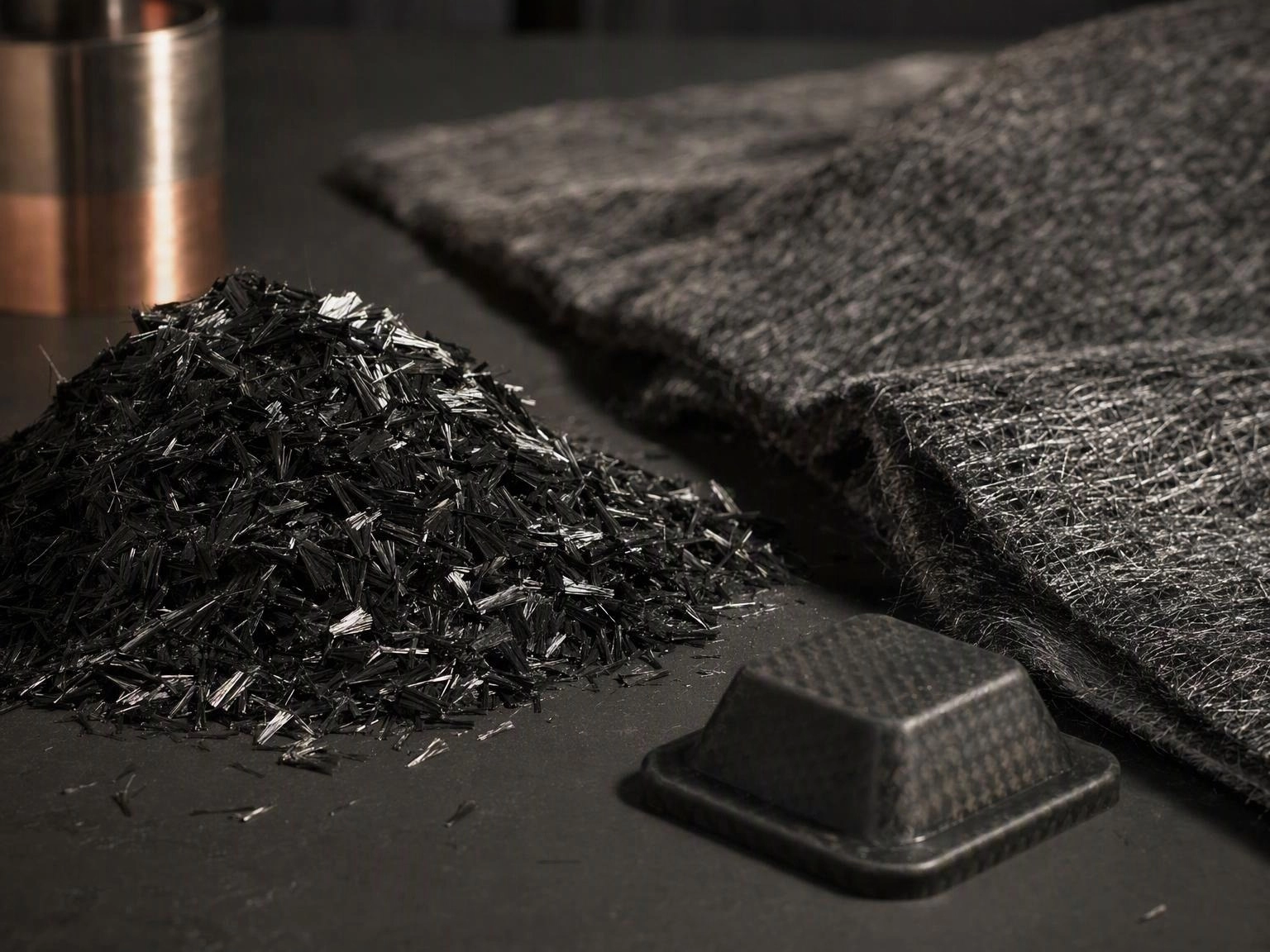
Recycled carbon fiber (rCF) is typically recovered as short, non-continuous tow or milled fiber. That limits it structurally: it cannot replace continuous fiber in a load-bearing laminate where the fibers must run the length of the part.
Where rCF genuinely works:
- Nonwoven mats and felts for compression molded parts, where random fiber orientation is acceptable.
- Chopped fiber reinforcement in SMC and BMC compounds.
- Milled fiber as a filler for friction, wear or conductivity applications.
- Housings, panels and non-structural components where the marketing value of “recycled carbon” outweighs the mechanical penalty.
Where it does not: structural tubes, drone arms, pressure vessels, primary automotive structure. In these applications the fiber must be continuous and aligned, and rCF cannot provide that.
The property penalty, stated honestly
Recycled fiber loses some tensile strength and modulus in the recovery process, and the loss varies with the recycling route and the source material. A supplier quoting rCF should be able to state the fiber's measured properties and the resulting laminate performance, not simply label the part “recycled”.
Beware of percentages without a basis. “Contains 30% recycled content” could refer to fiber weight, total part weight, or the cosmetic surface layer only. Ask which, and ask whether the figure is third-party verified.
Bio-based resins: the other half of the equation
Even with virgin fiber, the resin system can carry a meaningful sustainability story. Epoxy and polyester resins based partly on plant-derived feedstock are commercially available, and some formulations offer reduced cradle-to-gate emissions. Their process behaviour differs from conventional systems — viscosity, cure profile and sometimes glass transition temperature — so they need to be validated rather than substituted.
For a brand making a sustainability claim, the combination that reads most credibly is bio-based resin plus recycled fiber in a non-structural part, with a documented life-cycle assessment, rather than a single headline number.
Questions a buyer should ask
- What exactly is recycled, and at what percentage of total part weight?
- What are the measured mechanical properties of the recycled fiber and of the final laminate?
- Is the recycled content third-party certified, and by whom?
- Does the resin system change the processing window, and has it been validated at production scale?
- What is the end-of-life route for the finished part — can it be recycled again?
- Is there a documented LCA, and what scope does it cover?
Design decisions that reduce impact before recycling is needed
The most effective sustainability measure in composites is not recycling — it is using less material and making parts that last. Practical levers:
- Right-size the laminate: over-specified parts waste fiber for the life of the product.
- Design for disassembly so that metal inserts and fittings can be separated at end of life.
- Choose a thermoplastic matrix where the application allows it — it can be re-melted and genuinely recycled.
- Avoid mixing material families in a single part where separation will be impossible.
Shengtian's approach
Guangdong Shengtian Technology produces carbon fiber, fiberglass and SMC/BMC components, and is engaged with customers on sustainability requirements as they arise in specific programmes. Where a part can accept recycled or bio-based content without compromising its function, we will quote it and state the verified content and the resulting properties. Where the part is structurally continuous-fiber dependent, we will say so rather than sell a claim that cannot survive technical scrutiny.
If sustainability credentials are part of your product requirement, raise it at RFQ stage — it affects material selection, tooling and the documentation package.