
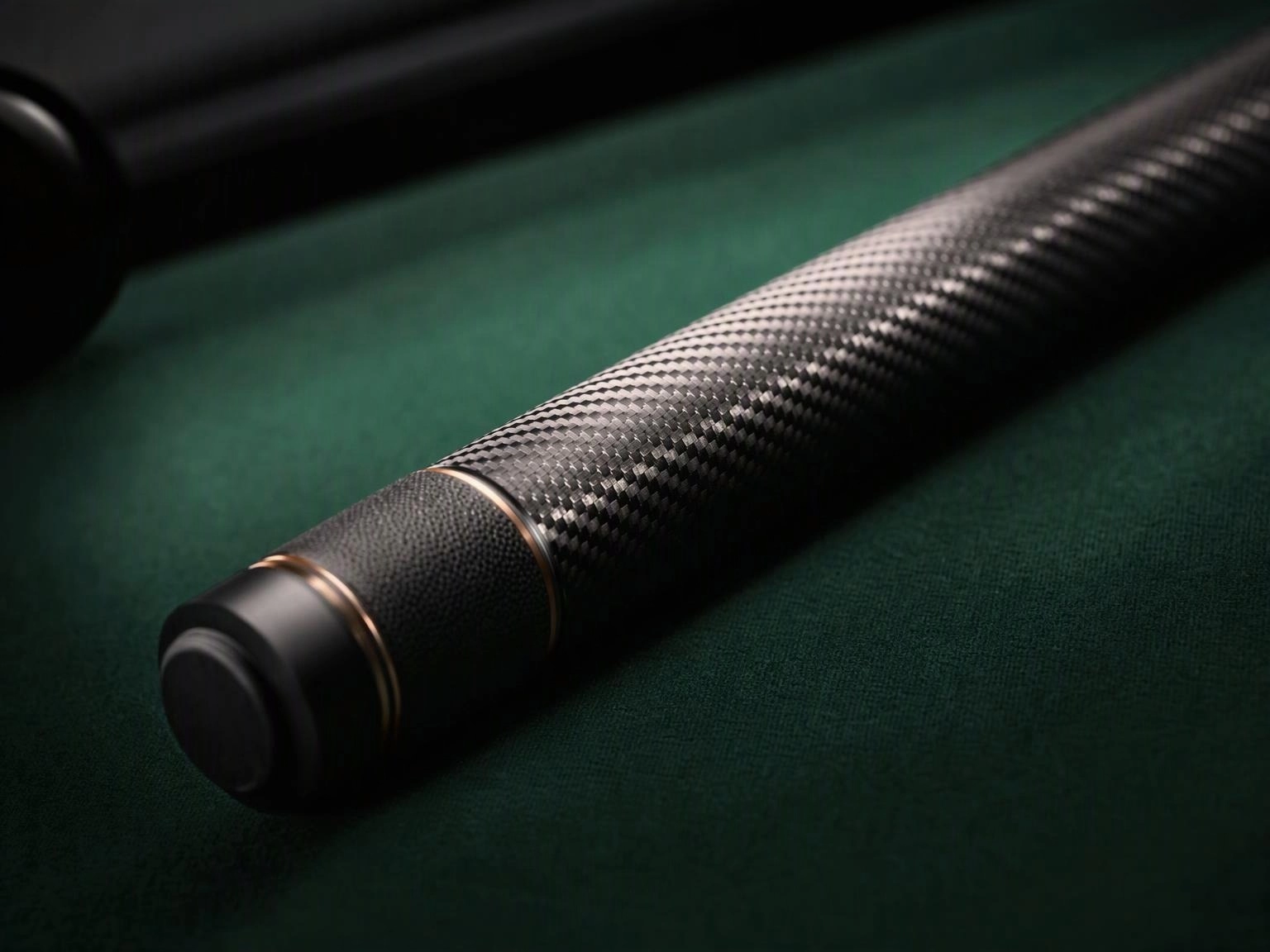
For most of the last century a cue shaft meant one thing: straight-grained maple, slowly air-dried, turned by hand. Carbon fiber shafts arrived as an expensive curiosity and are now a mainstream choice at every level of the game, from amateur league players to professional competitors.
The reasons are partly measurable and partly felt, and understanding both helps a brand decide whether a carbon shaft belongs in its range.
What a carbon fiber shaft actually is
A carbon shaft is a thin-walled composite tube. In our production it is roll-wrapped: multiple plies of 3K prepreg are wrapped under tension around a precision steel mandrel, cured under heat-shrink tape, the mandrel is extracted, and the tube is then ground, tapered, finished and jointed.
The final wall is typically only a few millimetres thick, yet the tube is stiffer than a solid wooden shaft of the same diameter and far more consistent from unit to unit.
Low deflection: the headline benefit
Deflection is the sideways movement of the shaft when the cue ball is struck with side spin. A stiffer, lighter front end reduces the amount of squirt imparted to the ball, so the player can aim closer to the true line when applying english.
Carbon achieves this in two ways: the specific stiffness of the fiber, and the ability to keep the front-end mass low and controlled. The hollow construction lets a designer place mass deliberately rather than accept whatever density a piece of wood happens to have.
Consistency: the benefit players notice second
Two maple shafts from the same tree can differ in density, grain run-out and stiffness. Two carbon shafts from the same mandrel and layup are, for practical purposes, identical. For a brand that ships thousands of cues a year, that consistency is worth as much as the performance: there is no need to sort, cull or re-taper shafts to hit a specification, and a replacement shaft for an existing customer feels like the one it replaces.
Durability and climate
Wood moves with humidity. A maple shaft that lives in a car in summer, or travels between a humid coast and a dry plateau, can warp, and a warped shaft is a permanent problem. A cured carbon tube does not absorb moisture in the same way and does not warp. It also resists dents from accidental knocks against a table edge, which is the most common cause of a “dead” feeling in a wooden shaft.
Two honest caveats: carbon shafts can chip if struck against a hard edge, and a deep gouge is not repairable the way a ding in wood can be sanded out. The surface finish also matters — a well-applied lacquer protects the resin from UV and hand oils, while a cheap finish will wear through at the bridge hand within a season.
Feel: the part that cannot be specified
Experienced players describe carbon shafts as “crisp” or “stiff”, and some prefer a softer hit. Feel comes from the whole system: wall thickness, taper, tip and ferrule, joint collar and butt construction. A factory that only sells a tube cannot tune this. A factory that builds complete shafts can vary wall thickness and taper to produce a family of feels from the same process — which is how brands differentiate a “power” shaft from a “control” shaft without changing material.
How a 3K shaft is specified and built
- Weave and look: 3K twill for the classic carbon appearance; coloured 3K for brand differentiation; gloss, satin or matte lacquer.
- Wall and taper: chosen to hit a target weight and balance point, with the joint end reinforced.
- Straightness: checked on a lathe or V-block; run-out measured along the full length, not at the ends.
- Joint and ferrule: machined to the customer's pin and ferrule standard, then bonded and finish-turned as one assembly.
- Cosmetics: weave alignment at the joint, no visible seam on the playing side, and a consistent pattern along the taper.
Sourcing considerations for cue brands
Tooling for a specific taper is the main up-front cost, so brands usually start with a stock taper and develop a proprietary profile once volume justifies it. Lead time depends less on wrapping than on the machined joint and the finishing steps, both of which are labour-intensive and hard to rush.
Guangdong Shengtian Technology roll-wraps 3K and coloured 3K carbon fiber tubes for billiard cue shafts and butt sections, and machines and finishes complete shafts to customer tapers. Because the same facility produces trekking poles, walking canes and other tapered tubes, the taper turning and finishing skills are already in place rather than being learned on your project.
Send a drawing or a sample shaft and we will quote the tube, the finished shaft, or both — whichever stage of the build you want to keep in-house.
3K carbon fiber billiard cue · Colourful 3K tubes · 3K roll-wrapped tubes