
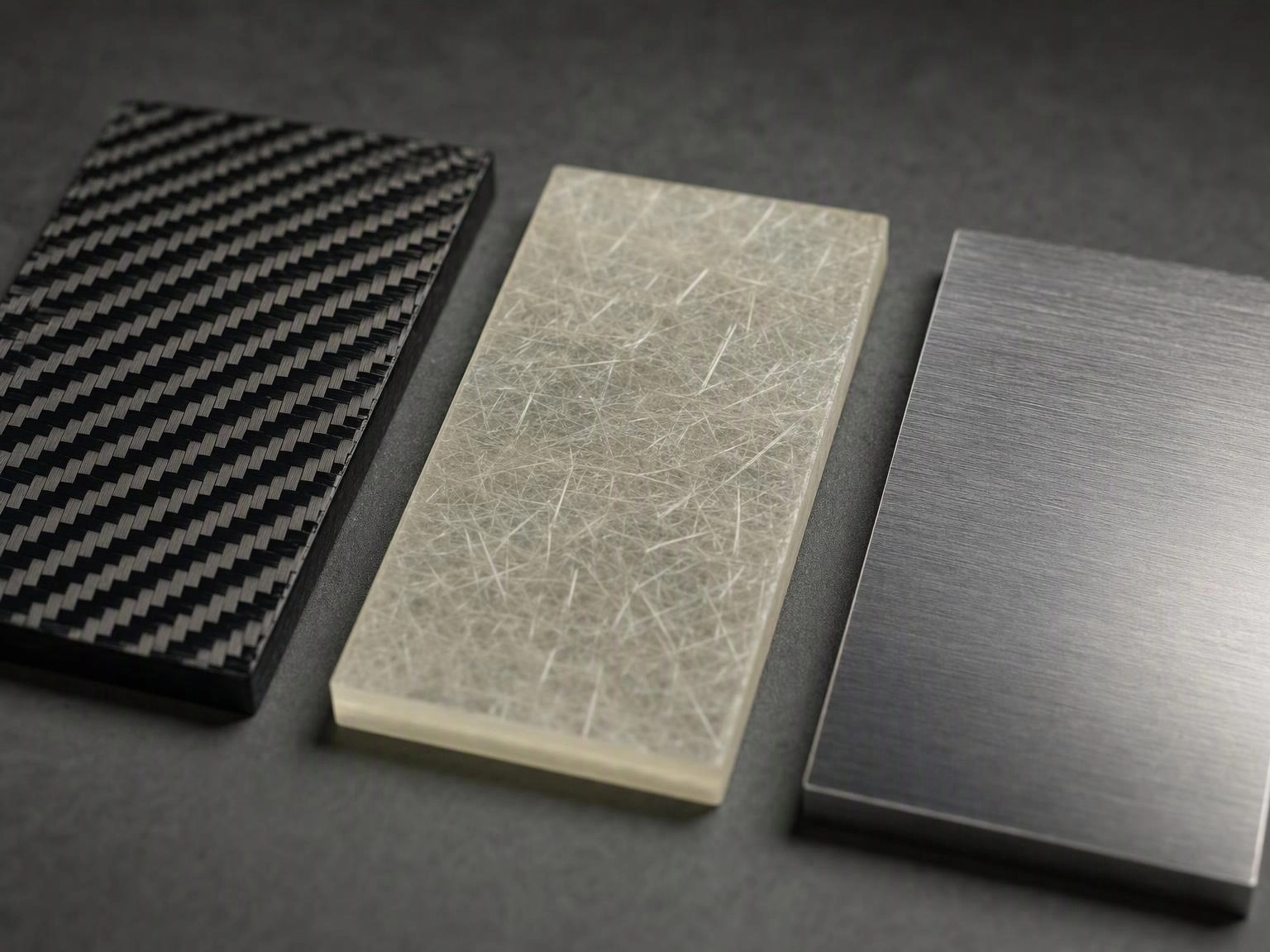
Every lightweighting project reaches the same crossroads: carbon fiber, fiberglass or aluminum. The marketing answer is always carbon fiber. The engineering answer depends on the load case, the environment, the production volume and the price the market will bear.
This article sets out the comparison the way a sourcing team actually needs it — not as a table of headline material properties, but as the trade-offs that decide which material ends up in the bill of materials.
The one number that usually decides it: specific stiffness
Carbon fiber composites reach specific stiffness (stiffness divided by density) several times that of aluminum, and roughly three to four times that of glass fiber composites in the fiber direction. In a part where deflection is the design driver — a drone arm, a tripod leg, a long boom — that ratio is decisive. You can meet the same deflection target with a much lighter part, or increase span without adding weight.
Aluminum is around 2.7 g/cm³ and isotropic, so it behaves the same in every direction and is easy to predict with standard FEA. Composites are anisotropic: the same laminate is stiff along the fibers and comparatively soft across them. That is an advantage when you design the layup around the load path, and a trap when you treat a composite as a drop-in replacement for metal.
Where fiberglass quietly wins
Glass fiber composites are heavier than carbon for the same stiffness, but they are electrically insulating, radio-transparent, corrosion resistant, tough in impact and dramatically cheaper per kilogram. For parts where stiffness is not the primary driver, fiberglass is often the better commercial choice:
- Housings and enclosures where the part must not block RF signals.
- Chemical and marine environments where aluminum would corrode and require coating.
- Large, low-stress panels where cost dominates — SMC/BMC moldings, construction formwork, utility covers.
- Parts that must flex rather than fail, such as leaf springs and impact guards.
In our own production, glass fiber rods and tubes serve exactly these roles: insulating rods, structural spacers, antenna supports and low-cost structural tube where carbon's price premium cannot be justified.
Where aluminum still makes sense
Aluminum remains the pragmatic choice for prototypes, low-volume machined parts, heat sinks and anything requiring tight tolerances and electrical conductivity. It is recyclable, available everywhere, and machine shops quote it quickly. The weakness is fatigue: aluminum has no true endurance limit, so welded or sharply notched structures loaded cyclically will eventually crack. Composites, by contrast, can be designed with a fatigue limit, which is why wind blades and aircraft structures are composite rather than aluminum.
Corrosion, galvanic risk and weather
Carbon fiber is cathodic relative to aluminum, and the two must never be bolted together without isolation — a galvanic couple will corrode the aluminum quickly, especially in salt or humidity. The fix is an insulating layer: fiberglass ply, isolating washer, or a protective coating. This is a detail that appears in almost no marketing comparison and in almost every field failure report.
Carbon composites themselves handle moisture and salt spray well when the resin and gel coat are properly specified, but UV exposure will degrade an unprotected resin surface. A clear coat or paint system is part of the product, not an optional extra.
Cost: material price versus landed cost
Raw material price is where carbon fiber looks worst — often several times the price of glass per kilogram, and well above aluminum. Landed cost narrows the gap considerably:
- Part count consolidation. A composite part can replace several metal pieces plus fasteners, cutting assembly labour.
- Tooling economics. Compression and pultrusion tooling is expensive up front but cheap per part at volume; machined aluminum is the opposite.
- Finishing. Aluminum needs anodising or painting to resist corrosion. A cosmetic carbon part may need only clear coat — or none at all, because the weave is the finish.
- Weight downstream. In a drone, a bicycle or a vehicle, every gram saved upstream saves propulsion or structure downstream. That value never appears on the material invoice.
A decision rule that holds up
- Stiffness or weight critical, complex load path, premium visible surface: carbon fiber.
- Cost critical, insulating or RF-transparent, corrosive environment: fiberglass.
- Tight tolerance, low volume, conductive or high-temperature: aluminum.
- Mixed requirements: hybrid — a carbon structural core with a glass insulating skin, or a pultruded carbon tube with machined aluminum inserts at the joints.
Guangdong Shengtian Technology produces all three families in-house — carbon fiber, fiberglass and SMC/BMC moldings — which means the material recommendation is not tied to a single production line. Our engineering team regularly talks customers out of carbon when glass or a hybrid does the job at a lower total cost.